So Meta finally said the quiet part out loud. Birthday fields are basically theater. Teens lie. Adults sometimes lie too. And the whole “are you 13?” checkbox has been a joke since around 2007. The new Meta AI age detection stack is the company’s attempt to stop pretending that self-reported ages mean anything, and it’s a much bigger shift than the press release lets on.
I’ve been tracking age-assurance tech across platforms for a while now. What Meta announced this week is the most aggressive move I’ve seen from any major US platform. Not because the AI is groundbreaking on its own, but because of where they’re pointing it.
What Actually Changed
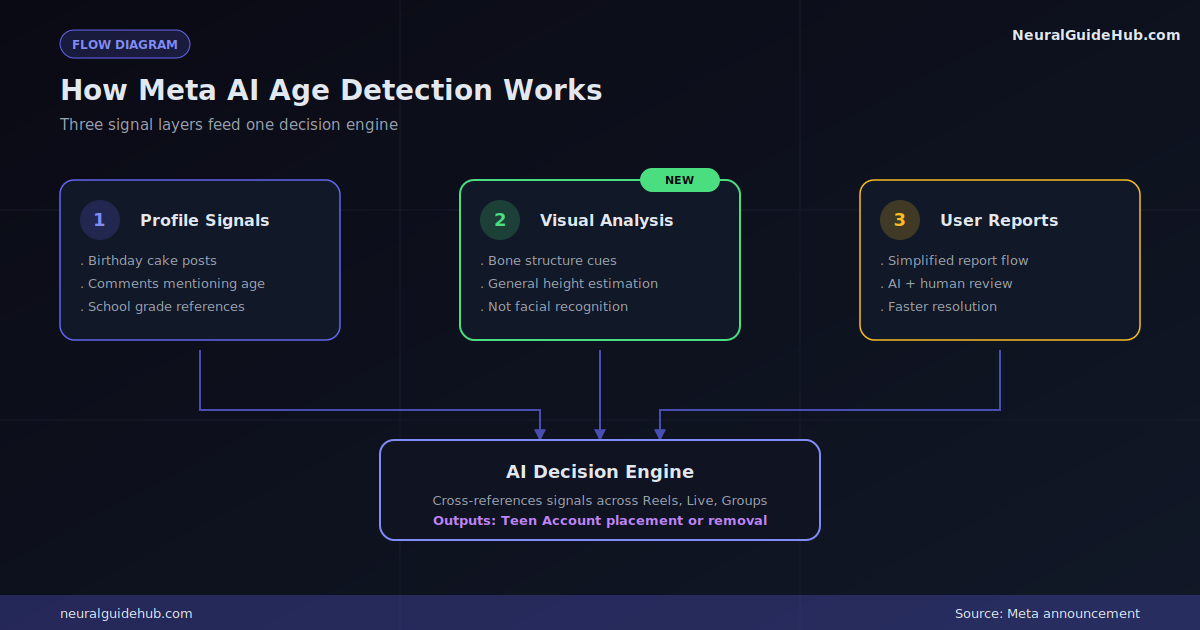
Three things, and they matter in different ways.
First, Meta is now using AI to scan entire profiles for context. Birthday cake posts, “happy 14th” comments, school grade mentions in bios, captions about prom or middle school dances. Anything that hints the account holder might be underage. This already exists in some form across the apps, but the company is now pushing it into Reels, Instagram Live, and Facebook Groups.
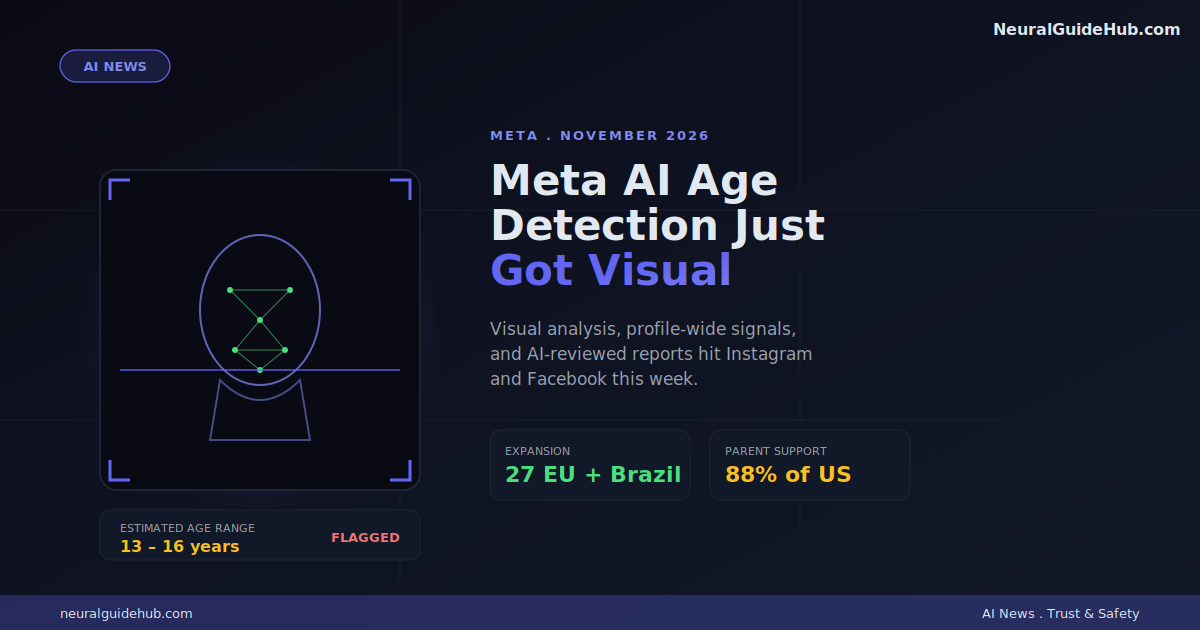
Second, and this is the one worth paying attention to, Meta added visual analysis. Their AI now looks at photos and videos to estimate a general age range based on things like bone structure and height. They’re being careful to say it’s not facial recognition. The system isn’t matching faces to identities, it’s just estimating “this person looks roughly 14 vs. roughly 25.”
Third, the report-an-underage-account flow got a rebuild. AI models now help review reports alongside humans, and according to Meta’s internal testing, the combo is faster and more accurate than human-only review.
Why Visual Analysis Is the Big One
Text-based detection has obvious gaps. A 14-year-old who never types “I’m in 8th grade” is basically invisible to a text-only system. But you can’t really fake your bone structure on camera.
That’s the leap. Worth knowing: this feature is currently rolling out in select countries first, not globally. Meta hasn’t published the exact list, which is its own quiet tell about how cautious they are with this one.
Teen Accounts Are Spreading Fast
Meta’s other big move is geographic. The system that proactively flags suspected teens and drops them into Teen Account protections, even when they’ve claimed an adult birthday, is now expanding hard.
Already live: US, UK, Canada, Australia on Instagram. Now rolling out:
- 27 EU countries plus Brazil on Instagram
- Facebook in the US, with UK and EU coming in June
- Global Instagram coverage targeted for later this year
Hundreds of millions of teens have been moved into these protected accounts since 2024. The new wave will push that number considerably higher. For context: Teen Accounts come with limits on who can DM, what kind of content shows up, and stricter defaults around private messaging.
The Parent Notification Play
This part feels almost diplomatic. Starting this month, US parents on Facebook and Instagram will get notifications nudging them to verify their teen’s age and have a conversation about being honest online.
Honestly? This is partly a legal hedge and partly a real thing. Meta knows enforcement-only approaches lose in court and lose with regulators. Parental partnership softens the optics. But there’s also evidence that parent-driven age accuracy actually works better than detection alone, especially for kids in that fuzzy 12-to-15 zone where signals get noisy.
The Real Subtext: App Store Pressure
Buried at the end of Meta’s announcement is the policy ask. They want app stores, meaning Apple and Google, to handle age verification at the OS level and pass that info to apps.
Meta cites a stat that 88% of US parents support this approach. The logic isn’t crazy. One verification at signup, one source of truth, instead of every app inventing its own system.
But it’s also a strategic shift. If Apple verifies ages, then Meta isn’t the company holding the bag when a 13-year-old slips through. The compliance burden moves to the operating system. Apple and Google have not exactly volunteered for this role.
What I’d Watch Next
A few things on my radar:
- False positive rates. Visual age estimation is hard around the 16-to-19 boundary. Adults who look young will get flagged. How does Meta handle the appeal flow?
- Privacy debate in the EU. Visual analysis on minors, even non-identifying analysis, will get scrutinized under DSA and GDPR. Watch for regulator commentary in the next few weeks.
- The Yoti integration. Meta still uses Yoti for facial age estimation when someone tries to change their birthday from under-18 to over-18. With internal visual analysis growing, the Yoti relationship could shift.
- Whether other platforms follow. TikTok, Snapchat, and YouTube all have their own age problems. If Meta’s approach holds up, expect copies within six months.
The bigger picture: Meta AI age detection isn’t really about catching teens anymore. It’s about Meta pre-empting regulation by being the company that visibly tried hardest. Whether that lands depends less on the tech and more on whether the false-positive stories stay quiet.
For now, if you’re a teen with a fake adult birthday on Instagram, your odds of getting flagged just went up considerably. And if you’re a parent? Check your kid’s account this week. The notifications are coming.