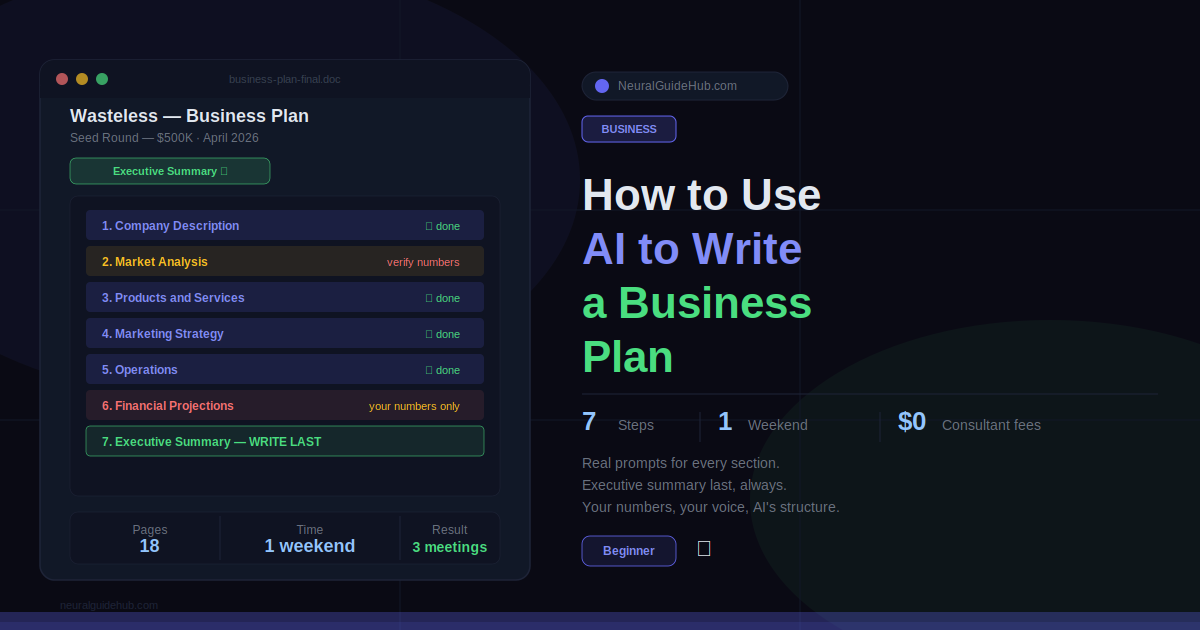
So here’s a thing that happened.
My friend Selin spent about three months writing a business plan last year. Three months. She had two consultants, a financial model in Excel with its own sub-tabs, and a Google Doc that she shared with me at some point that was honestly terrifying to open. The final plan was 38 pages. Cost her around four thousand dollars when you added everything up. She got one investor meeting. It went nowhere.
Fast forward to March. Same person, completely different approach. She needed a second plan for a pivot she was making. Did it over one long weekend using ChatGPT, Claude, and her own research. Fourteen pages. Got three meetings. Two of them turned into actual conversations. One became a check.
The difference wasn’t the quality of the business. Same person, similar idea space. The difference was that the blank page problem was gone. The “how do I structure this section” problem was gone. All that time she’d spent on formatting and structure in round one, the AI handled in round two. She spent her time on the actual thinking instead.
That’s what a good AI business plan process looks like. Not AI doing the thinking. You doing the thinking, AI handling the scaffolding. This guide covers exactly how to do that.
What You’ll Learn
- Why most AI business plan attempts fail in the first five minutes and what to do instead
- The one-page brief you write before touching any AI that makes everything else work
- Copy-paste prompts for every major section with real instructions that get real output
- Why executive summaries written first are almost always wrong and when to actually write yours
- Where AI makes stuff up and how to not get embarrassed by it in a meeting
- How to take a clean AI draft and make it sound like a person who believes in the business wrote it
What You Need
- ChatGPT or Claude. Free tiers work for drafting. Claude is better for long documents because it stays consistent across sections. ChatGPT is better if you want to iterate quickly on a specific part.
- Four answers you write yourself before opening any AI. What you sell. Who specifically buys it. How you make money. Who your actual competitors are. These have to exist in your head first.
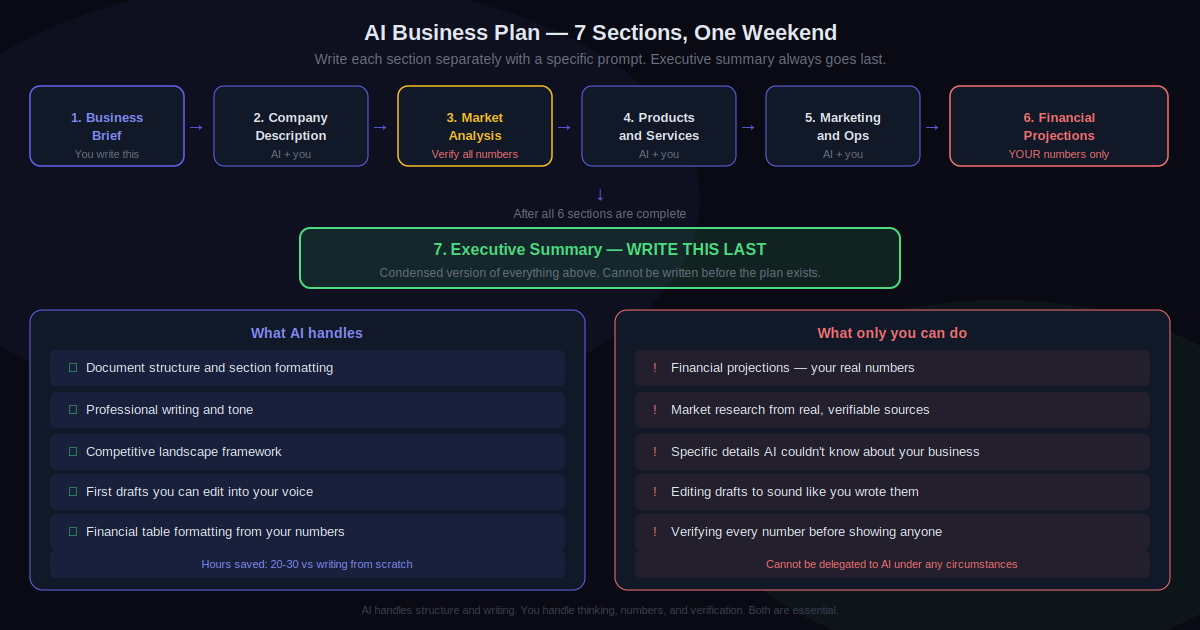
- Your own financial numbers. Non-negotiable. AI cannot invent accurate revenue projections for your business. The numbers come from you. AI formats them.
- Time. Six to eight hours for a solid first draft if you’ve done basic research beforehand.
Before we get into the prompts, something I want to be direct about because it trips people up constantly. AI makes up statistics. It does this confidently. Market size figures, competitor revenue estimates, industry growth rates — it will state these things like facts and sometimes they are completely fabricated. Every number the AI produces in your plan needs to be traced to a real source before that plan goes in front of anyone. One made-up stat in front of a serious investor ends the meeting. The prompts below include instructions to minimize this. They do not eliminate the risk. You verify the numbers. All of them.
Step 1: Write the Brief Before You Open AI
I know. Not exciting. Do it anyway.
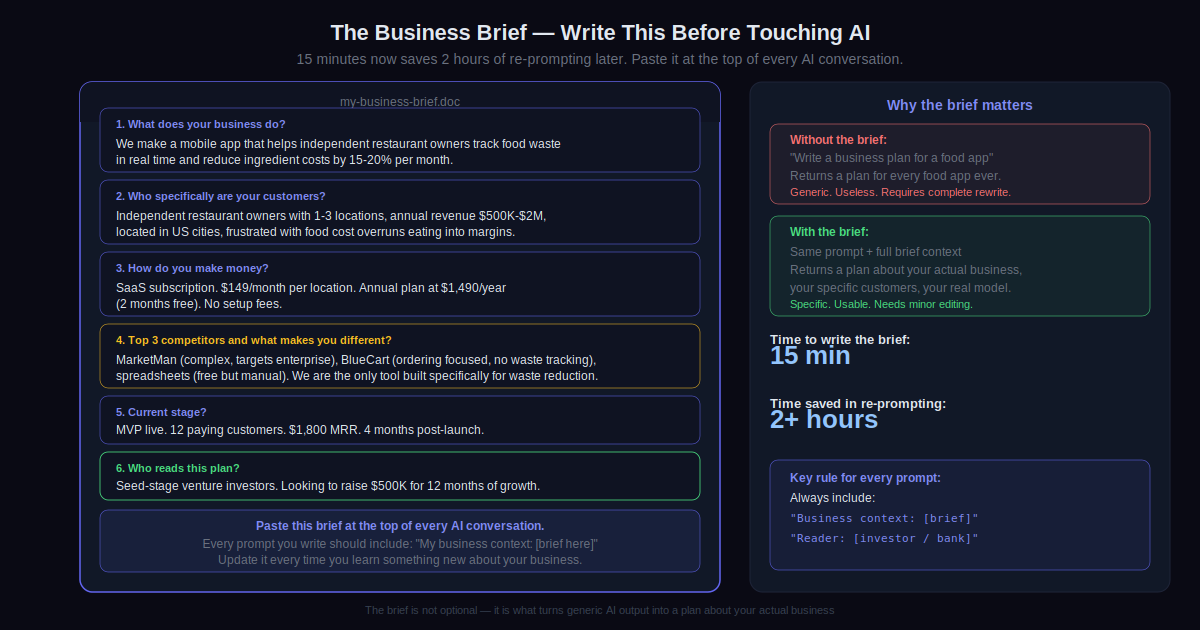
Open a blank document. Not ChatGPT. A blank document. Write answers to these six questions before you touch any AI at all:
- What does your business do and what problem does it actually solve?
- Who are your customers? Not “SMBs” or “millennials.” Specific people doing specific things.
- How do you make money? Subscription, one-time, service fees — be specific about the model.
- Who are your three main competitors and what makes you different from each?
- What stage are you at? Idea. Prototype. First revenue. Scaling.
- Who reads this plan? Investors, bank, partner, internal use?
That last question changes everything. A plan for a venture capitalist reads nothing like a plan for a bank loan officer. VCs want market size and growth. Banks want cash flow and repayment. Tell the AI who it’s writing for in every prompt you ever run and the outputs shift automatically in the right direction.
Paste this brief at the top of every AI conversation you open. Every single one. It’s the context that makes generic output become specific output. Without it you get something that sounds like a template for a company nobody has met.
Step 2: Company Description
Start here. Not the executive summary. The executive summary is a condensed version of the other sections. You cannot summarize what you have not written yet. People keep doing this and then wonder why the summary sounds hollow. Step 7 covers the executive summary. Do not skip ahead.
Prompt:
Write the company description section of a business plan. My business context: [paste your brief]. Reader: [investor / bank loan officer / partner]. Include: what the business does and the specific problem it solves, legal structure and founding date, mission statement in one sentence, any real traction or milestones we have achieved so far, and our long-term vision in two sentences. Under 300 words. First person plural. Professional but not stiff. Do not use the words innovative, cutting-edge, or best-in-class anywhere.
What comes back will have solid structure. The voice will probably need work. Add the real specifics the AI cannot know. A signed customer. A patent pending. A grant received. An actual hire you’ve made. One concrete real thing does more for this section than three paragraphs of vision language. Add the real stuff and cut anything that sounds like boilerplate.
Step 3: Market Analysis
Most valuable section in the whole plan. Also the one where AI is most likely to make things up. So before you run this prompt, do your own research on your market size and growth rate. Government databases, industry reports, Statista, IBISWorld. Even a rough number from a real source is better than a precise number from nowhere. Paste whatever you find into the prompt.
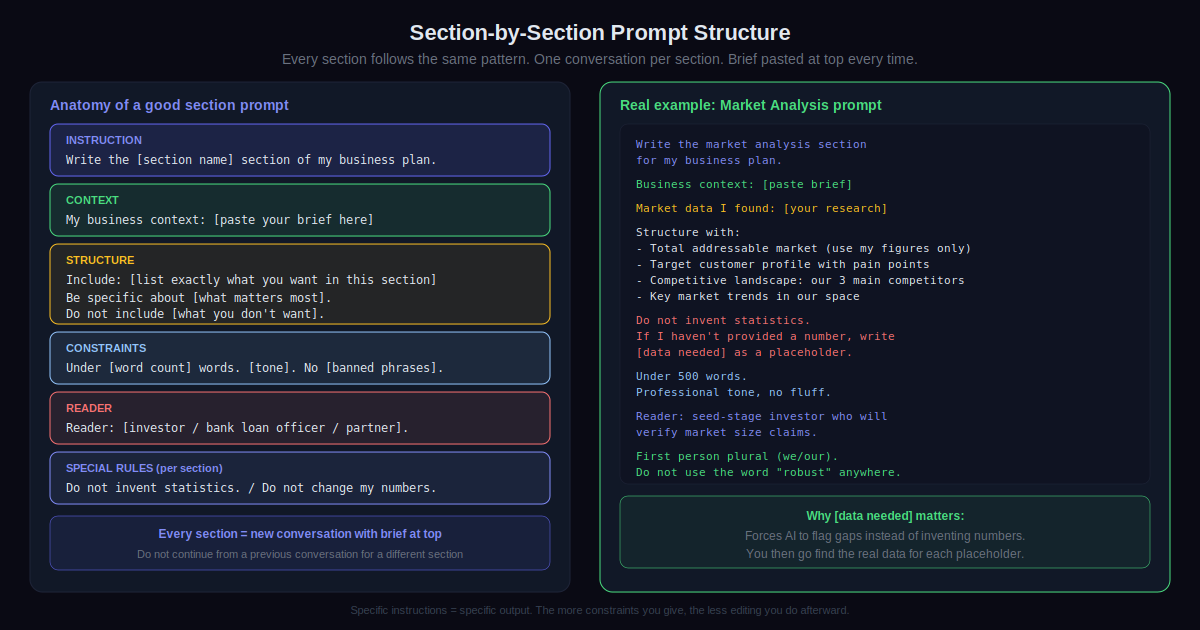
Write the market analysis section for my business plan. Business context: [paste brief]. Market data I found: [paste your actual research here]. Structure the section with: total addressable market using only the figures I provided, target customer profile with specific demographics and pain points, competitive landscape covering our top three competitors and how we differ from each, and key market trends relevant to our space. Do not invent statistics. If I have not provided a number, write [data needed] as a placeholder instead of guessing. Reader: [investor / bank].
The “[data needed]” instruction is the important part. It forces the AI to flag gaps rather than fill them with invented confidence. Then you go back and find real numbers for each placeholder. Slower. More defensible. Worth it every time you’re showing this to someone who might actually check.
Step 4: Products and Services
Describe what you sell and how it solves the problem. AI first drafts here tend toward vague marketing language. Push hard for specifics in the prompt.
Write the products and services section of my business plan. Business context: [paste brief]. Describe: what we sell and how it specifically solves the customer problem, any intellectual property or proprietary features that competitors don't have, our pricing model and why it makes sense for our target customer, and what we plan to build or add in the next 12 to 18 months. Be specific about what the product actually does. Do not use phrases like "best in class" or "industry leading." Say what it does, not how great it is. Under 400 words.
“Say what it does, not how great it is” is doing a lot of work there. Without that instruction you get marketing copy. With it you get product description. Investors know the difference within the first paragraph.
Step 5: Marketing and Operations
Two sections. Run them separately. Start a new conversation for each one with the brief at the top.
Marketing and sales:
Write the marketing and sales strategy for my business plan. Business context: [paste brief]. Include: the specific channels we will use to acquire customers and why each one fits our business, our sales process from first contact to signed deal, any customer acquisition cost or lifetime value data we have, and our customer and revenue goals for year one. Only include strategies that make sense for our specific business. Skip anything generic. Under 350 words.
Operations:
Write the operations section for my business plan. Business context: [paste brief]. Describe: how we deliver the product or service on a daily basis, our current team and the specific roles we need to hire in the first 12 months, our main technology or supplier dependencies, and the key operational risks we face and how we plan to address each one. Practical, specific, no filler. Under 350 words.
After both are done, read them back to back. AI writes each section without knowing what it wrote in the other. Contradictions happen. The marketing section might assume a sales team the operations section says you can’t afford for six months. You catch that. Fix it before moving on.
Step 6: Financial Projections
This is where you do the most work yourself.
AI cannot produce accurate revenue projections for your specific business. It will produce numbers that look completely plausible and are completely untethered from your actual situation. Your job before running this prompt: calculate your own projections. Take your price, multiply by realistic customer counts year by year, subtract your main costs. Basic. But yours.
Write the financial projections section of my business plan. My numbers: [paste your actual revenue and cost figures]. Format the section with: a three-year revenue projection in a table using exactly the numbers I provided, a breakdown of major expense categories, startup costs and funding needed if applicable, and a brief explanation of the assumptions behind the revenue projections. Do not change or adjust any figures I have provided. If a number seems off to you, note it but keep it exactly as I wrote it. Reader: [investor / bank].
“Do not change or adjust any figures” is in there because AI sometimes quietly “corrects” your projections toward what it thinks is more reasonable. Your projections are yours. The AI formats and contextualizes them. It does not revise them.
Step 7: Executive Summary — Write This Last
You have six complete sections now. Paste them all into one document. Then:
Here is my complete business plan: [paste everything]. Write a one-page executive summary that a busy investor can read in under two minutes. Include: what the business does and the problem it solves in two sentences, the market opportunity and why now, what makes our product different from the alternatives, our revenue model and three-year projections from the plan, the team and why we are the right people to execute this, and our funding ask with specific uses. Lead with the single most compelling point about the business. Do not include any information not already in the plan. If something is not there, leave it out.
Read this one very carefully. The executive summary is the first page and the last thing you wrote. It can feel slightly disconnected from the rest. Check every number matches. Fix inconsistencies. This page carries the whole document. Give it time.
Pro Tips
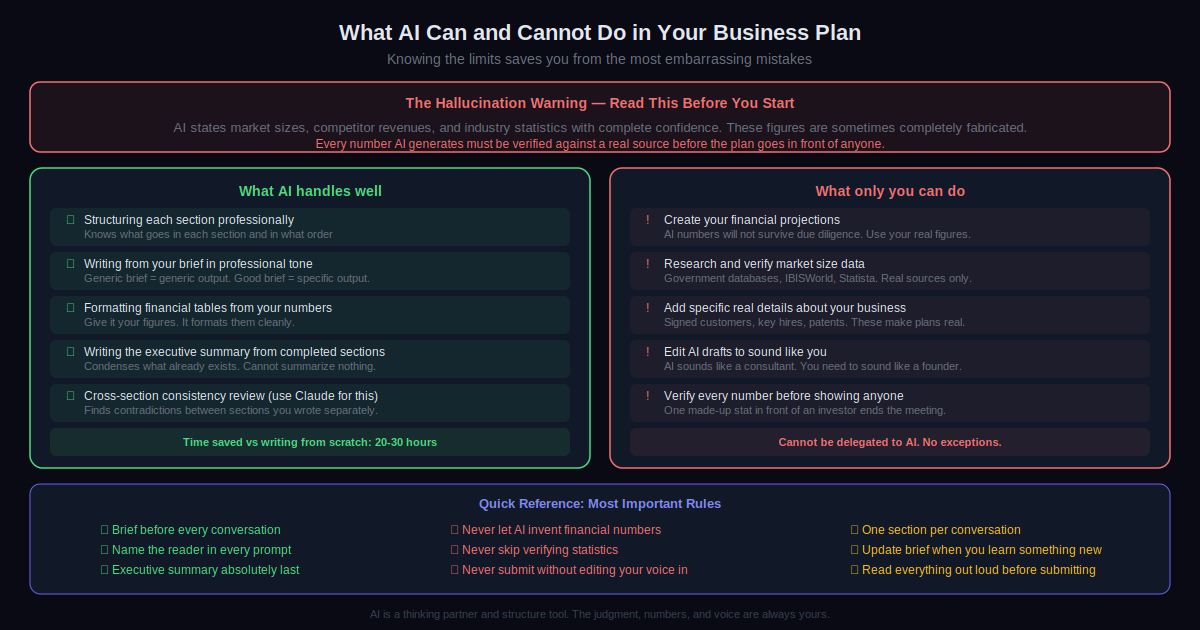
- One section per conversation, every time. Asking for multiple sections together produces shallow output across all of them. The extra setup of starting a new conversation with the brief pasted at the top takes five minutes and improves the output significantly. Worth it without exception.
- Name the specific reader in every prompt. “Write this for a VC who reviews 300 decks a year” produces a different document from “write this for a regional bank officer reviewing an SBA loan application.” Emphasis, tone, and structure all change. Tell the AI who is reading. Every time.
- Use Claude for a final pass across the whole plan. Once all sections are drafted in ChatGPT, paste the full document into Claude and ask: “Find any inconsistencies between sections, claims not supported by earlier content, and places where the tone shifts noticeably.” Claude handles document-level review better than ChatGPT. They complement each other.
- Add your real details before calling any section done. Signed customers. Specific hires already made. Awards, partnerships, grants. One verifiable real thing beats three paragraphs of vision language every time. These are what make a plan feel like it belongs to an actual business rather than a hypothetical one.
- Update the brief every time you learn something new. If writing the market analysis changes what you think about your target customer, update the brief before writing the next section. The brief is the source of truth. Outdated brief equals outdated plan.
- Every number gets a source before the plan goes anywhere. If you cannot point to a real citation for a market figure, either replace it with one you can verify or flag it clearly as an internal estimate. Investor due diligence starts with the numbers. One unverifiable stat raises questions about everything else in the document.
Common Mistakes to Avoid
- Writing the executive summary first. Still happening constantly. The summary summarizes the plan. Without the plan, it is guesswork. Write the six sections. Then write the summary. It takes thirty extra minutes and the quality difference is significant enough that I genuinely don’t understand why people keep skipping this.
- Letting AI invent the financial projections. The financials are where due diligence starts. AI-generated revenue figures not grounded in your actual pricing and customer reality will not survive the first follow-up question from anyone serious. AI formats the numbers. You create them. This is the one task in this guide that has no shortcut.
- Not editing for your own voice. AI business writing sounds like a consultant wrote it for a company they’ve never visited. Professional, clean, and completely generic. Your plan needs to sound like you actually know and believe in this business. Read every section out loud. Rewrite anything that sounds like a template. Investors fund people. The plan is the paper version of your conviction.
- Skipping the brief. Every person who skips it ends up spending more time re-prompting trying to get the AI to understand their business than they would have spent writing the brief in the first place. Fifteen minutes. Not optional.
- One big prompt for the whole plan. “Write my complete business plan” produces a document that is wide, shallow, and unconvincing. The depth comes from focus. One section per conversation. A shallow plan does not get funding. A deep one that took an extra four hours does.
Next Steps
Open a blank document right now and write the brief. Answer the six questions from Step 1. Give it fifteen minutes. This document is the foundation everything else in the guide builds from and it has nothing to do with AI.
After that, do the market research before writing any sections. Real numbers for your market size, from a real source you can name. This is the one step you cannot hand to AI and it is worth getting right before you write a word of the actual plan.
Then work through sections in order. Company description first. Executive summary absolutely last. One section per sitting if you can manage it. Two hours total for a complete rough draft if you stay focused.
The plan won’t be finished after one pass. Business plans never are. But it will be a real document, built on your real numbers, in your real voice, structured in a way that holds up when someone actually looks at it. Selin’s first plan took three months and $4,000. Her second took a weekend. Same person. Different process. What you do with the extra eleven weeks is up to you.