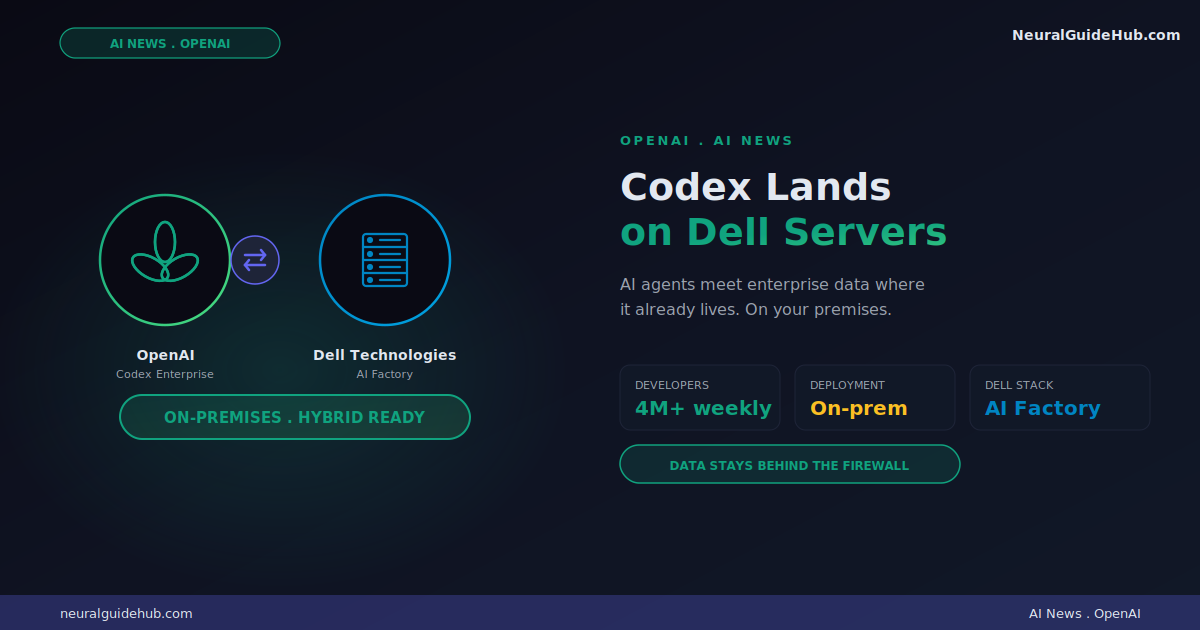
OpenAI and Dell just announced something big for enterprise IT. The OpenAI Dell partnership brings Codex directly into hybrid and on-premises environments. That means Codex can finally run next to the data it’s supposed to work on, instead of asking enterprises to ship sensitive data out to the cloud.
This is the move I’ve been waiting for. Codex hit four million weekly developers. The bottleneck for enterprise adoption was never the model. It was data location.
What the partnership actually does
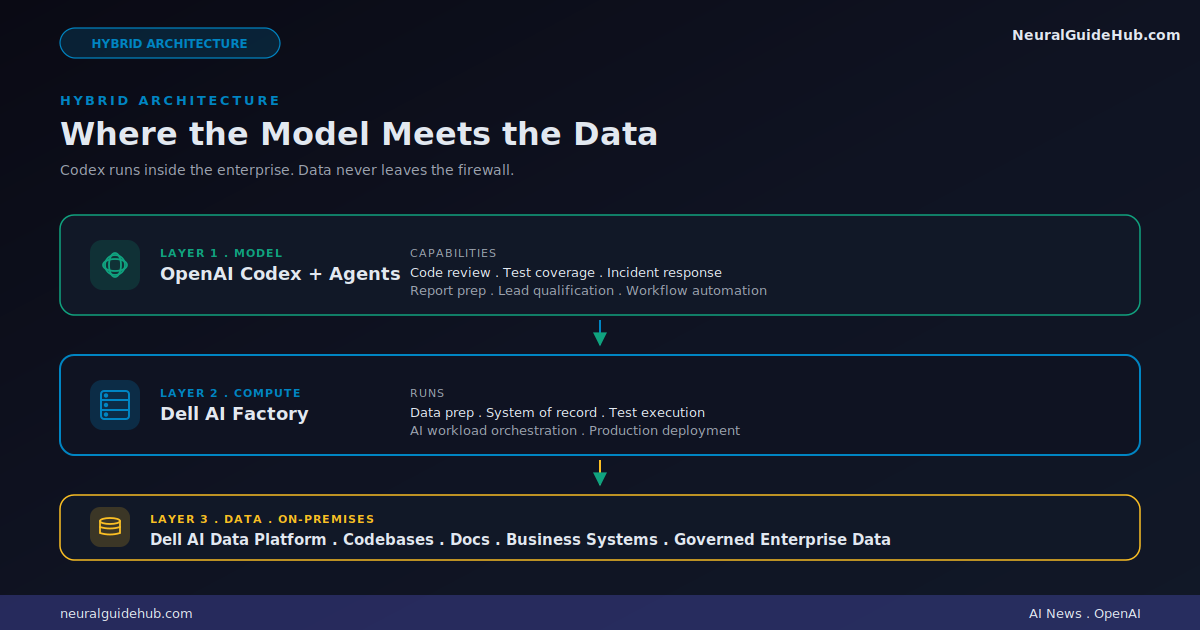
Two integrations matter. The first is Codex connecting with the Dell AI Data Platform. Many enterprises already use this to store, organize, and govern data on-premises. Codex will plug in there directly.
The second is exploring how Codex, ChatGPT Enterprise, and other OpenAI APIs interface with the Dell AI Factory. That’s the system enterprises use to power AI workloads. It runs data prep, system of record management, test execution, and deployment.
Together, these two pieces let enterprises run Codex inside their own walls instead of crossing the perimeter.
Why on-premises matters this much
Most large enterprises have a stack split problem. The data lives in their data center. The AI models live in the cloud. Bridging the gap means either moving data out (security headache) or running AI on stale copies (effectiveness headache).
Banking. Healthcare. Defense. Manufacturing. All of these have regulatory or contractual reasons to keep data inside their own infrastructure. Without on-premises options, AI deployment stops at PowerPoint.
Dell already runs the infrastructure these companies use. Codex now slots into that infrastructure. That’s a different conversation than “send us your code and we’ll process it.”
Codex is moving beyond coding
The interesting framing in the announcement is that Codex isn’t just a coding tool anymore. Teams are using Codex-powered agents for context gathering, report prep, product feedback routing, lead qualification, follow-up writing, and cross-system coordination.
That broadens the target audience significantly. The original Codex pitch was “AI for developers.” The new pitch is closer to “AI agents for any knowledge work that touches enterprise systems.”
For Dell, that’s a much bigger TAM than coding alone. Every department that touches operations, sales, or support becomes a Codex deployment opportunity.
What enterprises actually get
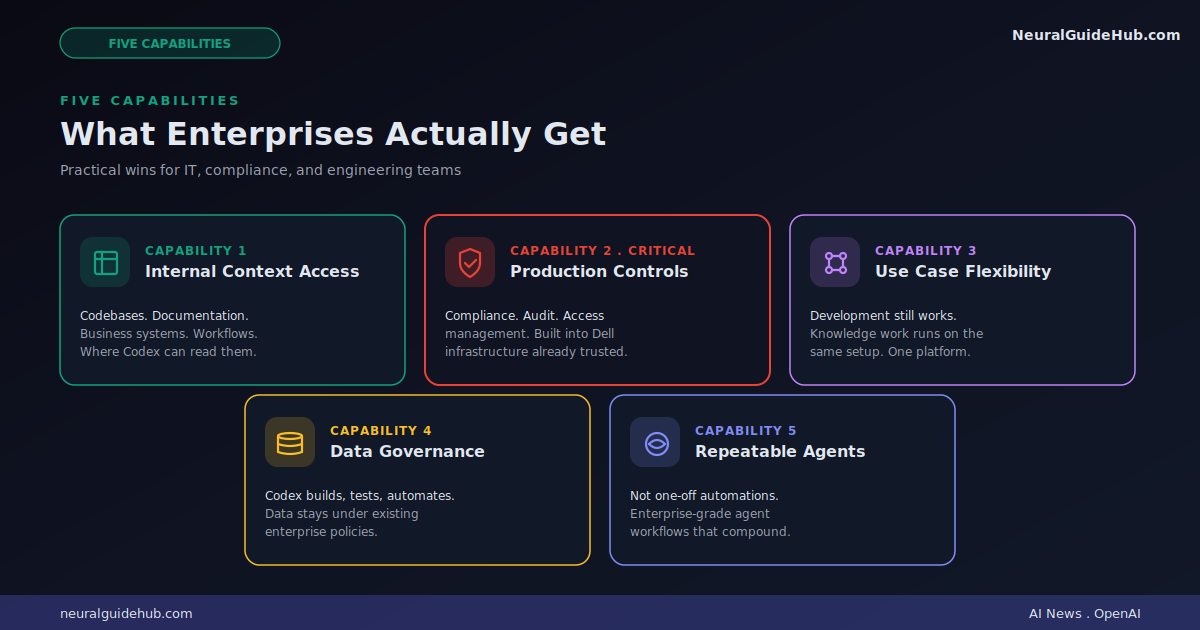
Five concrete capabilities show up in this partnership.
Closer access to internal context. Codebases. Documentation. Business systems. Operational knowledge. Team workflows. The stuff that makes agents actually useful, sitting where Codex can read it.
Production-grade controls. The compliance, audit, and access management that large organizations require. Built into Dell infrastructure the enterprise already trusts.
Flexibility across use cases. Software development still works. Knowledge work runs on the same setup. No need for separate tooling per department.
Data governance. Codex can build, test, automate, analyze, and act with full context, but the data stays governed by existing enterprise policies. No shadow copies floating around.
Repeatable agent systems. Not one-off automations. Enterprise-grade agent workflows that compound across teams.
The competitive picture
Anthropic recently pushed Claude into AWS Bedrock for enterprise deployment. Google is shipping Gemini through Vertex AI. Both routes assume the workload runs in the cloud.
The OpenAI Dell partnership goes the other direction. The model meets the data on the customer’s premises. For regulated industries, this is the only path that actually works.
Dell isn’t a flashy choice for AI infrastructure. They’re the practical one. PowerEdge servers. Storage arrays. The hardware enterprises already bought and depreciated. Adding Codex on top of that stack lowers the friction enormously.
What Dell gets out of this
This is also a meaningful win for Dell. They’ve been positioning the Dell AI Factory as the enterprise AI platform. Adding Codex as a partner workload validates that positioning. Customers who were debating Dell AI Factory now have a concrete reason to commit.
Ihab Tarazi, Dell’s SVP and CTO for Infrastructure Solutions, framed it directly. Dell AI Factory with OpenAI Codex gives customers a practical, secure path to deploying AI agents at scale. Inside their own premises. Where their data already lives.
That’s the pitch enterprise IT directors have been asking for. Not flashy demos. Real deployment paths.
What I’d watch for next
How does pricing work for on-premises Codex? Cloud pricing is per-token. On-premises usually shifts to per-seat or licensed compute. The economics will determine which size of enterprise can afford this.
What’s the deployment timeline? Hybrid AI rollouts have a track record of taking 12-18 months. The first reference customers in 2026 will tell us how realistic that timeline is for this partnership.
How does model updating work? Cloud Codex gets new model versions automatically. On-premises deployments traditionally lag. The mechanism for keeping on-prem Codex current is the part that will decide long-term value.
The bigger pattern
Enterprise AI is splitting into two paths. Cloud-first for digital-native companies. On-premises for regulated, traditional enterprises. The OpenAI Dell partnership stakes a clear claim on the second path.
For any IT leader who’s been waiting for the right moment to deploy AI on internal data, this is the green light. Practical infrastructure. Top-tier model. Enterprise controls. The three pieces finally line up.
Worth a conversation with your Dell rep this quarter if your roadmap includes Codex.