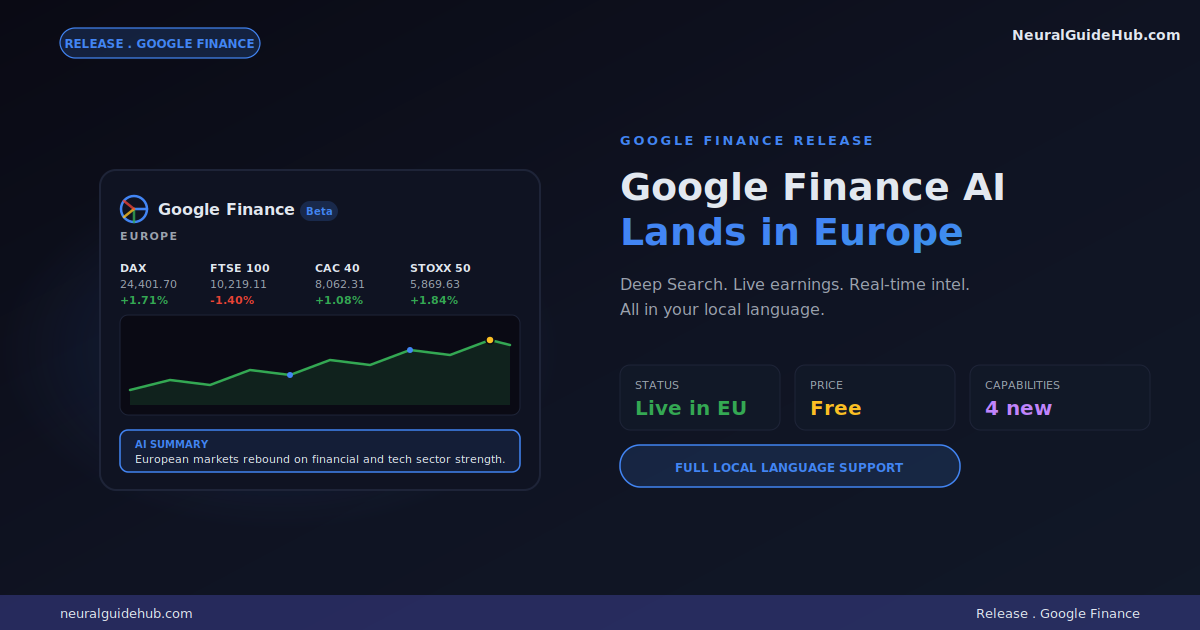
Google has been quietly rebuilding Finance into an AI-first product since the beta rolled out in the US earlier this year. This week the upgraded experience lands in Europe with full local language support. I’ve been waiting for this rollout because the US version has been one of the more underrated AI integrations I’ve tested in 2026. The new Google Finance AI isn’t just a redesign. It’s a different product underneath, built around natural-language research, deeper data, and live audio that turns earnings calls into something you can actually scan.
I’ve been using the US beta for a few months. The European launch matters because it brings four capabilities that genuinely change how retail investors and analysts approach market research. Here’s what’s shipping and why I think it’s a bigger deal than the announcement suggests.
Why this rollout actually matters
Most financial tools haven’t really been rebuilt around AI yet. They’ve added chatbots on top of the same old screens. The new Google Finance is different. The AI is the interface, not a sidebar. You ask questions in plain language and the whole experience rearranges itself around your query.
For European users this matters more than it might for US ones. Continental retail investors have been underserved by AI-driven research tools, which have mostly been English-only and US-market focused. Full local language support changes that. Someone researching DAX or CAC 40 in their native language now gets the same quality of AI synthesis that a Bloomberg terminal user has had for years.
The four big upgrades shipping in Europe
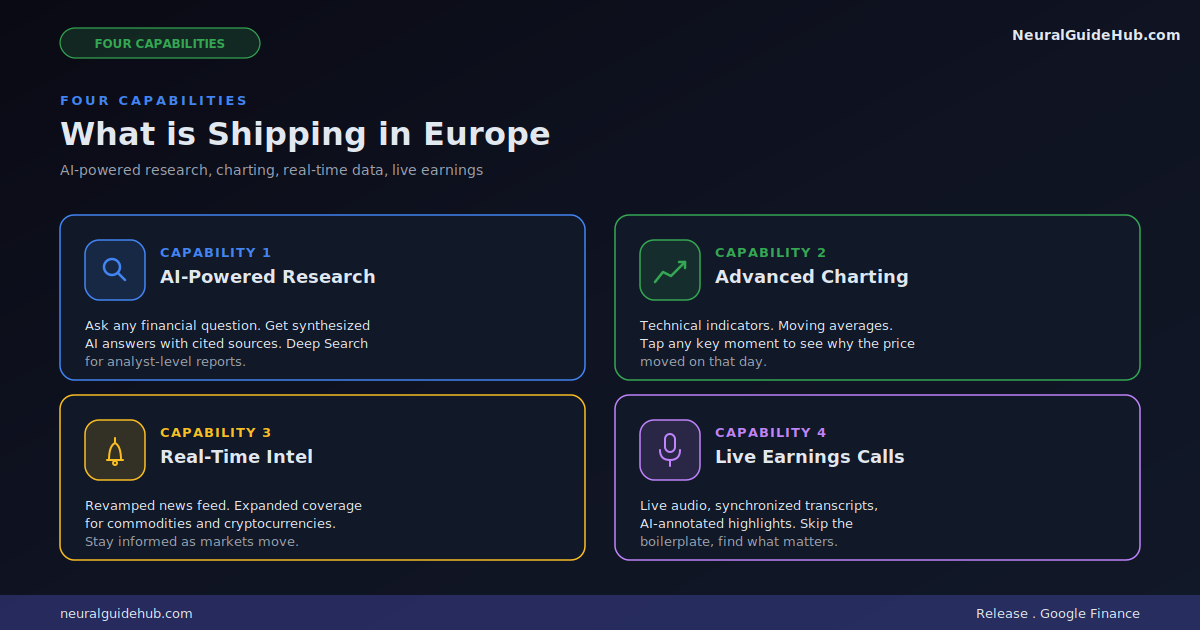
Google’s announcement covers four headline capabilities. Each one stands on its own. Together they reshape how research happens day to day.
AI-powered research with Deep Search
You can ask about anything from an individual stock to a broader market trend. The AI returns a synthesized answer with links to the underlying sources. For more complex questions, Deep Search runs longer, pulls more material, and produces something closer to an analyst note than a quick answer.
Deep Search is the feature I’d point to first. The standard AI response is fine for “What happened to ASML today?” Deep Search is for “How are European semiconductor companies positioned against US tariff policy this quarter?” Different questions, different depth of work.
Advanced charting and technical indicators
The new charting tools go past basic historical performance. You get technical indicators like moving average envelopes built directly into the interface. The detail I like most is the ability to tap a key moment on a stock chart and immediately see why the price moved that day. No more flipping between the chart and a news feed trying to correlate dates.
Real-time intel for commodities and crypto
The revamped news feed runs alongside expanded data coverage for commodities and cryptocurrencies. The previous Google Finance treated commodities as an afterthought. The new version makes them feel native. Same for crypto, where coverage now matches the depth Google offers for equities.
For European retail investors who care about energy markets and FX, this fills a real gap. Most consumer-grade tools have been weak on commodities. Google now has serious coverage built into a free product.
Live earnings calls with AI annotations
This is the capability I’d flag as most novel. You can follow corporate earnings calls with live audio, see a synchronized transcript as the call happens, and get AI-generated insights highlighted alongside the speakers.
The annotated highlights are the actual differentiator. Earnings calls run an hour or more. Most of that hour is boilerplate. The AI flags the moments that matter, like a guidance change or an analyst question that got an unusual answer. You scan instead of listen end-to-end.
How the experience reads in practice
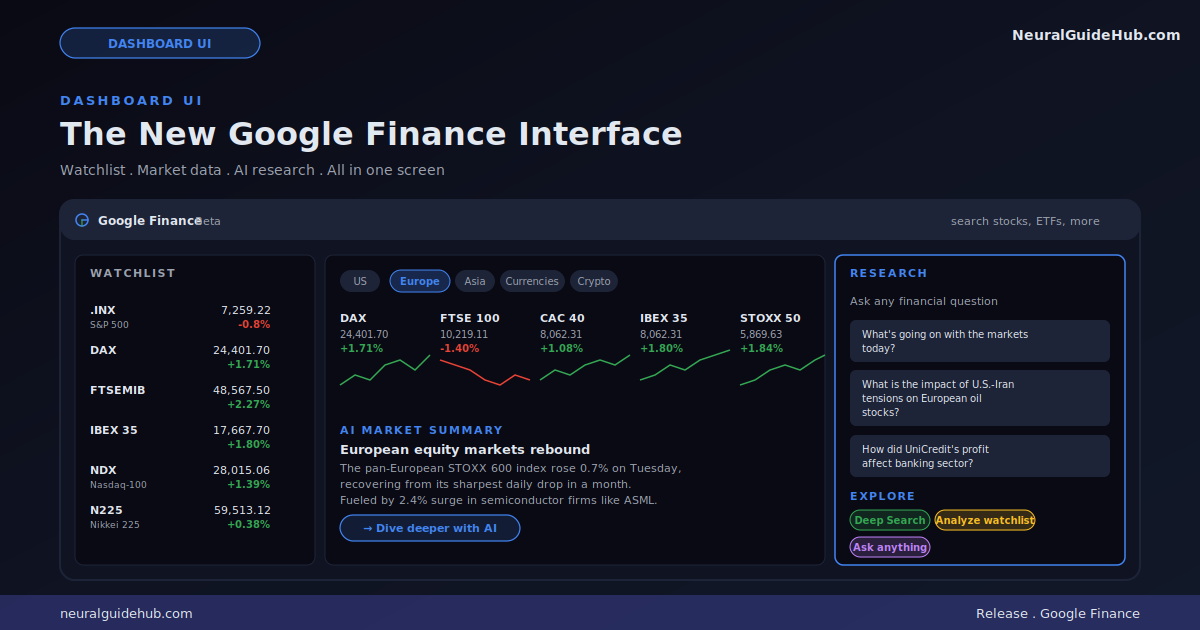
I’ve spent enough time in the beta to have opinions. The Watchlist sidebar feels familiar. The market summary area is where the AI shows up most visibly. It writes a few sentences explaining what’s happening across the index you’re viewing, with citations to the sources it pulled from.
The Research panel on the right is the part that surprises new users. You ask any financial question and the AI responds. Pre-built prompts like “What’s going on with the markets today?” and “How did UniCredit’s record profit affect the broader banking sector?” suggest the kinds of questions Google expects users to ask.
The Explore section adds three quick actions: Deep Search, Analyze my watchlist, and Ask anything. These shortcuts cover the bulk of what I’d want to do in a typical research session.
What I’d watch for next
A few open questions for anyone evaluating Google Finance AI as a research tool.
How accurate is Deep Search on lesser-known European stocks? US large-caps have abundant training data. Mid-cap European companies are a different test. My early experience says coverage is decent but not perfect.
Does the AI cite sources well enough to verify claims? The interface shows sources, but quality matters. For high-stakes research, you still need to click through and read the underlying material. The AI is a synthesizer, not a substitute.
What’s the relationship with Google’s other AI products? Gemini sits behind a lot of this. The way Finance integrates with Gemini Deep Research and the broader Google ecosystem will shape how much power users get out of the platform over time.
Who should care about this launch
Retail investors in Europe are the obvious audience. Free, AI-powered, native-language financial research has not really existed at this quality level before. Most retail traders pay for screening tools or get by with worse free alternatives. Google Finance now sits in a different category.
Financial journalists and content creators are the second group. The Deep Search and live earnings features compress hours of work into minutes. For anyone writing about markets daily, that’s a meaningful efficiency gain.
Professional analysts probably won’t replace their Bloomberg or FactSet workflows. But for quick checks, second opinions, or starting points for deeper research, this is a competitive tool. The price is also unmatched. Free beats every other consumer-grade option I’ve tested.
Where this fits in the AI finance race
The bigger picture is that AI-driven financial research is becoming a free commodity. What used to require a $24,000-a-year terminal subscription is now available in a browser tab for the cost of a Google account. The quality gap between professional and consumer tools is closing faster than I expected.
Bloomberg and Refinitiv still own institutional workflows. They have decades of data depth and integration. But for the long tail of retail and prosumer users, Google Finance AI is now a credible alternative. The European rollout extends that reach significantly.
If you’re in Europe and you research markets at all, this is worth opening up this week. The learning curve is small. The capability gain is real. And the price stays at zero.
https://blog.google/products-and-platforms/products/search/ai-powered-google-finance-in-europe/