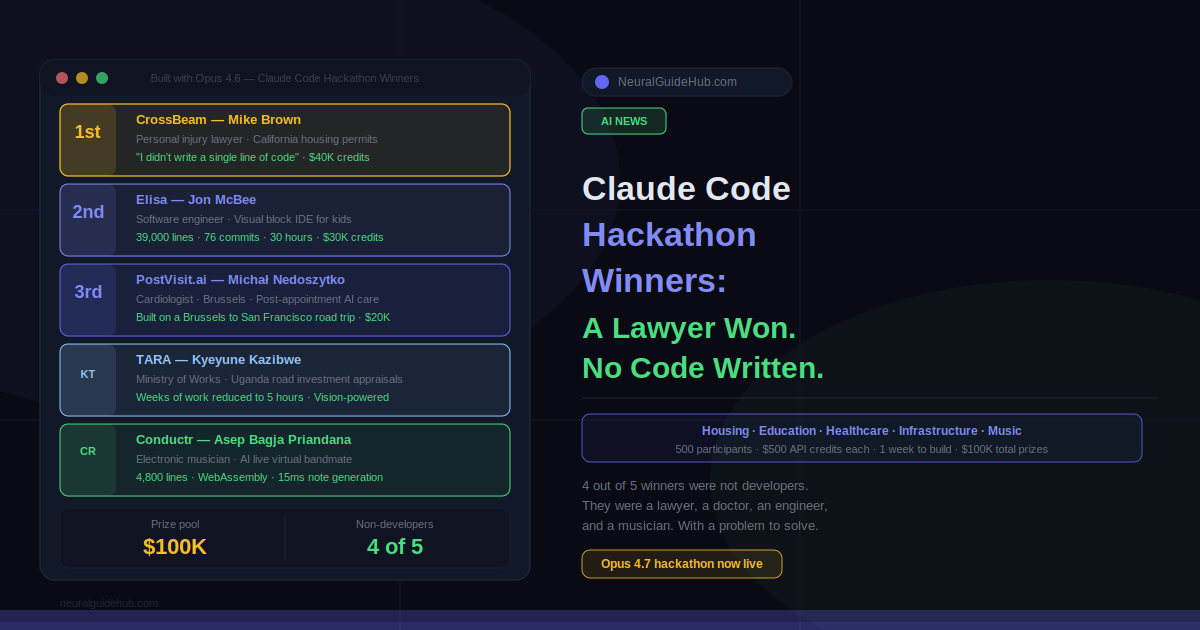
The results of Anthropic’s Built with Opus 4.6 Claude Code hackathon are in, and the winner did not write a single line of code. Not one. He is a personal injury lawyer from California who built a tool that might actually help solve a housing crisis. The runner-up built an IDE for his twelve-year-old daughter’s science fair project. Third place went to a Brussels cardiologist who built the tool he had been imagining for two years while on a road trip to San Francisco.
Four out of five winners were not professional software engineers. That is worth sitting with for a moment. Anthropic partnered with Cerebral Valley, selected 500 participants, gave each $500 in API credits and one week to build something. Six winners split $100,000 in Claude API credits. This is what they built.
First Place: CrossBeam — Mike Brown
California has a 90-plus percent permit rejection rate on first submission. The average delay is six months. That delay costs homeowners roughly $30,000. The kicker is that most rejections are bureaucratic — wrong code citation number, missing signature, incomplete form. Not structural problems. Paperwork problems.
Mike Brown, a personal injury lawyer, looked at this and built CrossBeam. His framing is direct: “Everyone thinks California has a housing crisis. We don’t. We have a permit crisis.” Builders drag and drop blueprints and correction letters into the tool. Parallel sub-agents parse the documents, build a spatial index, and assign targeted agents to each discrete issue. Twenty minutes later, the builder has a precise action plan for approval.
CrossBeam works on both sides of the desk. Municipalities can batch-process submitted permits and generate draft correction letters automatically. Buena Park, a Southern California city that needs to permit more than 8,900 housing units by 2029 but only permitted around 120 in 2024, is looking at adopting it. That is not a pilot. That is a city with a documented problem talking to the tool that might fix it.
How did Mike build it? He prompted Claude Code and had Claude write the tests. “It’s crazy to me that I ended up winning this contest,” he says, “and I didn’t write a single line of code. I didn’t even read a line of code.”
Second Place: Elisa — Jon McBee
Jon McBee’s twelve-year-old daughter needed to program microcontrollers for a seventh-grade science fair project. He wanted her to use Claude Code, the same tool he relies on as a software engineer. The problem is obvious: a terminal interface is not designed for a middle schooler.
So he built Elisa. It is a block-based visual IDE where users design software by snapping together primitives — goals, requirements, agents, skills, rules, portals, deployments — while the AI writes the actual code behind the scenes. A meta-planner decomposes the visual spec into a task graph. Agents handle execution. A built-in teaching engine surfaces age-appropriate explanations of the programming concepts being used, so every build is also a lesson.
Jon built Elisa in 30 hours of actual work: 76 commits, over 39,000 lines of code, more than 1,500 tests. “I know systems architecture. I know how to integrate hardware. I know how to define and test software,” he says. “Claude Code helped me turn all that knowledge into a shippable product in only six days.”
Educators are already reaching out about classroom deployment. Jon is working to fund that effort with the $30,000 in Claude API credits from second place. He named the project after his daughter because, as he puts it, she is exactly who it is for.
Third Place: PostVisit.ai — Michał Nedoszytko
Michał Nedoszytko is a Brussels-based cardiologist who has spent 20 years building healthcare software alongside his medical practice. He already had Previsit.AI, an AI patient intake system deployed in Belgium, Greece, and Poland. What he had been trying to build for two years was its counterpart: what happens after the appointment.
PostVisit explains diagnoses in plain language, analyzes visit notes and AI-scribe transcripts, and surfaces relevant clinical evidence from scientific resources and full health records, with physician oversight throughout. Patients understand their own care better. Physicians get visibility into how patients are doing between appointments.
Michał built PostVisit on a road trip from Brussels to San Francisco. “On the road is where my best ideas come to life,” he says. One week and a few thousand miles later, he had the product he had been imagining for years. “Medicine is based on evidence. And now, by combining health records, evidence, and visit data, the patient has complete control and understanding of what happens after the visit.”
“Keep Thinking” Prize: TARA — Kyeyune Kazibwe
Uganda has more road infrastructure needs than budget to address them. Traditional feasibility studies cost $1 to $4 million, take nine to fourteen months, and focus on economic projections without accounting for the communities the roads are meant to serve. Kyeyune Kazibwe, who worked at Uganda’s Ministry of Works and Transport, built TARA to change how those decisions get made.
TARA turns dashcam road footage into a complete investment appraisal. Opus 4.6’s vision capabilities analyze every frame, identifying surface conditions, distress patterns, and roadside activity including pedestrians, cyclists, and market stalls. The system segments the road into condition sections, auto-populates intervention costs, and generates a full economic appraisal with NPV, cash flow projections, and sensitivity analysis. It also produces an equity score that assesses who actually benefits from the investment.
For the hackathon, Kyeyune used actual dashcam footage from Kira-Matugga Road, currently under construction in Uganda. “One click generates a complete PDF report: condition assessment, economic analysis, equity findings, sensitivity interpretation, all in one document,” he says. “This process used to take weeks. TARA does it in five hours.”
Special Prize for Creative Exploration: Conductr — Asep Bagja Priandana
Asep Bagja Priandana built Conductr to give musicians a live AI bandmate. The browser-based MIDI instrument listens as you play chords on a controller, analyzes your performance, and generates four tracks in real time: drums, bass, melody, and harmony. Type “make it funky” or “build to a climax,” and the arrangement changes mid-jam.
The hard part was keeping the music uninterrupted. A C engine compiled to WebAssembly generates notes every 15 milliseconds, so the AI’s decisions reshape the arrangement without breaking the flow. Latency is, as Asep describes it, “musically invisible.”
Conductr runs on about 4,800 lines of JavaScript and WebAssembly. Lean for an instrument that listens, thinks, and plays alongside you in real time.
What This Hackathon Actually Showed
The Built with Opus 4.6 Claude Code hackathon produced five winners across housing, education, healthcare, infrastructure, and music. Four of them were not professional developers. That pattern is the real story here. A lawyer, a cardiologist, a roads engineer, and a musician built production-quality tools in a week using Claude Code without writing code themselves.
The next hackathon, Built with Opus 4.7, is already underway. Anthropic and Cerebral Valley are selecting 500 participants, giving each $500 in API credits, and awarding another $100,000 in prizes. Based on what the first cohort built, it is worth paying attention to what comes next.
https://claude.com/blog/meet-the-winners-of-our-built-with-opus-4-6-claude-code-hackathon