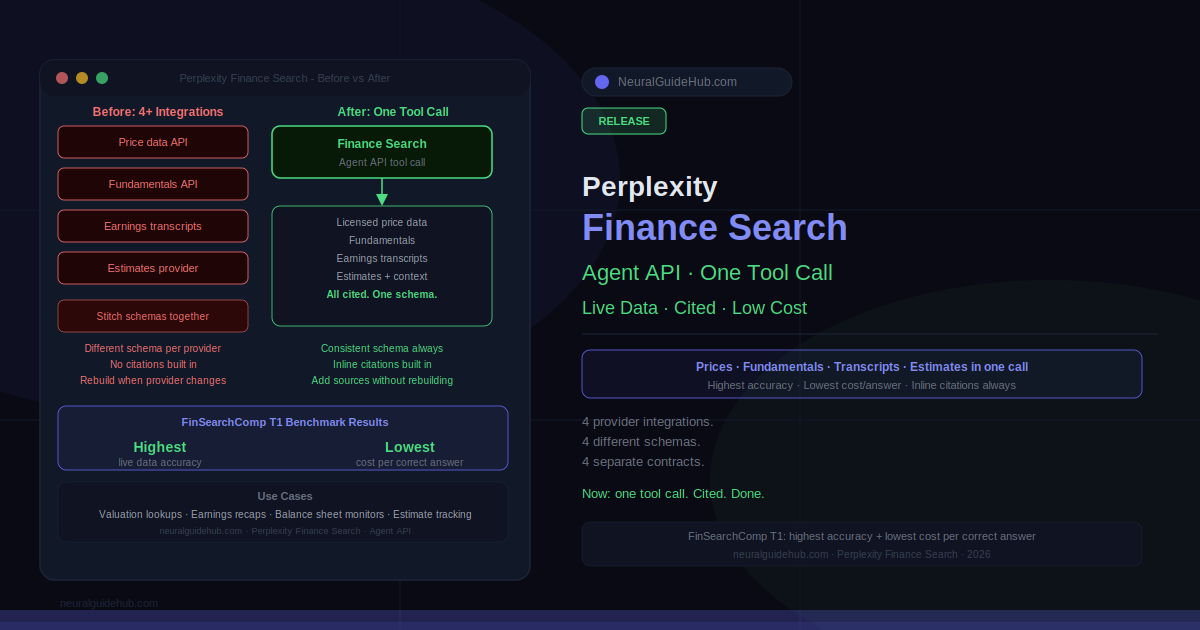
Building a financial agent usually means stitching together four or five different data providers. One for real-time prices. Another for fundamentals. A third for earnings transcripts. A fourth for estimates. Each with its own API contract, its own response schema, its own rate limits. And after all that integration work, you still have a model that might hallucinate a figure it couldn’t find. Perplexity Finance Search, launched today in the Agent API, replaces that entire stack with a single tool call that returns cited results from licensed sources in a consistent format.
What Perplexity Finance Search Actually Does
One tool call. The model sends a request — valuation lookup, earnings recap, market monitor — Finance Search routes it to the relevant licensed sources, and returns cited results in a consistent schema regardless of which provider produced the answer. The agent works from those results. Cites them. Continues the workflow.
The design choice matters. Most financial agents today send the model to search generic web results and hope it finds accurate, current data. Finance Search skips that entirely and routes directly to structured licensed datasets. The model never has to process pages of irrelevant web text to find a price or a line from an earnings call. It gets the data, cited, in a format it can use immediately.
Four use cases Perplexity specifically calls out: a valuation lookup combining current price, segment results, and earnings commentary; a monitor tracking changes across balance sheets, income statements, and cash flows; an earnings recap connecting reported numbers to management commentary; and a research assistant following estimate revisions over time. All of these previously required separate integrations for each data type.
The Benchmark Numbers
Perplexity ran Finance Search against FinSearchComp T1 — a time-sensitive financial data retrieval benchmark measured after market close, which is where live data accuracy matters most. Two results worth noting.
First: Finance Search started with the highest accuracy for live financial data and remained the most consistently accurate configuration over time. Not a one-point lead — the gap held as the benchmark ran.
Second: it had the lowest cost per correct answer in the cohort. The reason is architectural. Because Finance Search retrieves data directly from structured sources, the model works from a small number of highly relevant tokens rather than processing large amounts of web text to find an answer buried somewhere. Fewer tokens in, same or better answer out. That’s a meaningful cost advantage at the query volumes financial agents run.
Why the Stable Interface Matters for Developers
The schema consistency is the underrated part of this release. Finance Search returns results in the same format regardless of which underlying provider produced them. The application doesn’t need to handle provider-specific response structures. When Perplexity adds a new data source or category, the tool interface stays the same — developers don’t need to rebuild around it.
Every result includes inline citations. Which source produced the answer, which figure the model used. That’s not optional in finance. An analyst or risk officer needs to be able to trace a number back to its source before acting on it. Building that traceability into the tool output rather than leaving it to the developer to implement separately removes a meaningful piece of integration work.
Developers choose the model, view token usage, and configure Finance Search for their application. The docs include the configurations that performed best in the benchmark — tested defaults rather than starting from zero.
Perplexity Finance Search and the Broader Finance Context
Perplexity already has traction in professional finance. Analysts and investors use it for company research and investment material preparation. Finance Search takes that same retrieval capability and makes it available to agents — so the accuracy that works for a human doing manual research also works for an automated workflow running at scale.
Computer for Professional Finance, Perplexity’s existing product for finance teams, uses this same data surface to produce tearsheets, market monitors, earnings recaps, and research memos. Finance Search in the Agent API is the developer-facing version — same underlying capability, accessed programmatically rather than through a product interface.
The practical implication for teams building financial agents is significant. Right now, the alternative is either integrating each licensed provider separately — expensive, time-consuming, and fragile — or relying on a model to search the open web for financial data, which produces inconsistent results on time-sensitive queries. Finance Search sits between those options and handles the retrieval layer so the agent can focus on the reasoning and output layer. Documentation is live, configurations from the benchmark are included as defaults.
https://www.perplexity.ai/hub/blog/introducing-finance-search-in-the-agent-api