Most AI products want to live in your browser tab. Perplexity just decided that’s not enough. The new Perplexity Personal Computer ships AI agents directly onto your Mac, where they can read your local files, drive your native apps, browse the web, and keep working while you sleep. It’s a notable departure from how almost every other AI assistant operates today. And the choice of platform tells you exactly what they’re betting on.
I’ve been watching agent products evolve for a while now. Most of them are still tied to a chat window. You ask. They respond. Conversation ends. What Perplexity is shipping is structurally different. Long-running work that continues quietly in the background and surfaces when it needs you. That’s a different relationship with computing.
What Personal Computer Actually Is
Quick context. Perplexity has been building toward this for over a year. The path went something like this:
- Perplexity (the answer engine): ask a question, get a synthesized answer with citations
- Comet (the browser): AI agents running inside web pages, doing work in the browser context
- Perplexity Computer (cloud): autonomous teams of agents running on Perplexity’s servers
- Personal Computer (new): the same agent system, but running on your actual Mac
Each step extends the surface area where agents can do work. The new piece is local execution. Your files. Your apps. Your machine.
Why the Mac, Why Now
The choice of macOS first isn’t accidental. The Apple ecosystem gives Perplexity something Windows or web couldn’t: tight handoffs across devices.
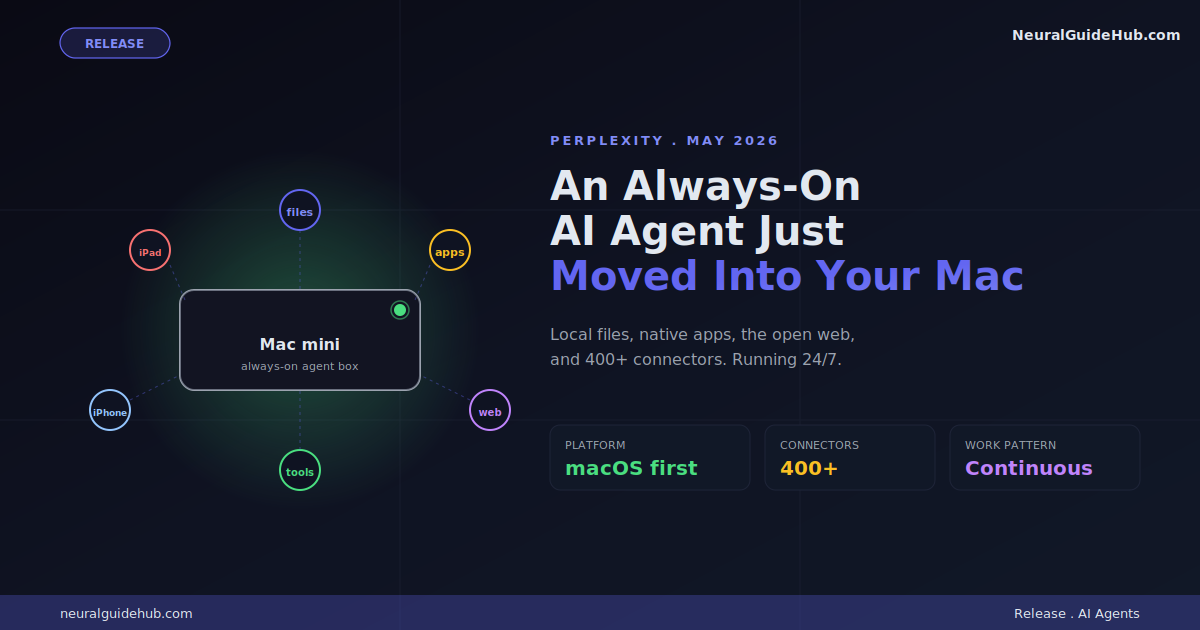
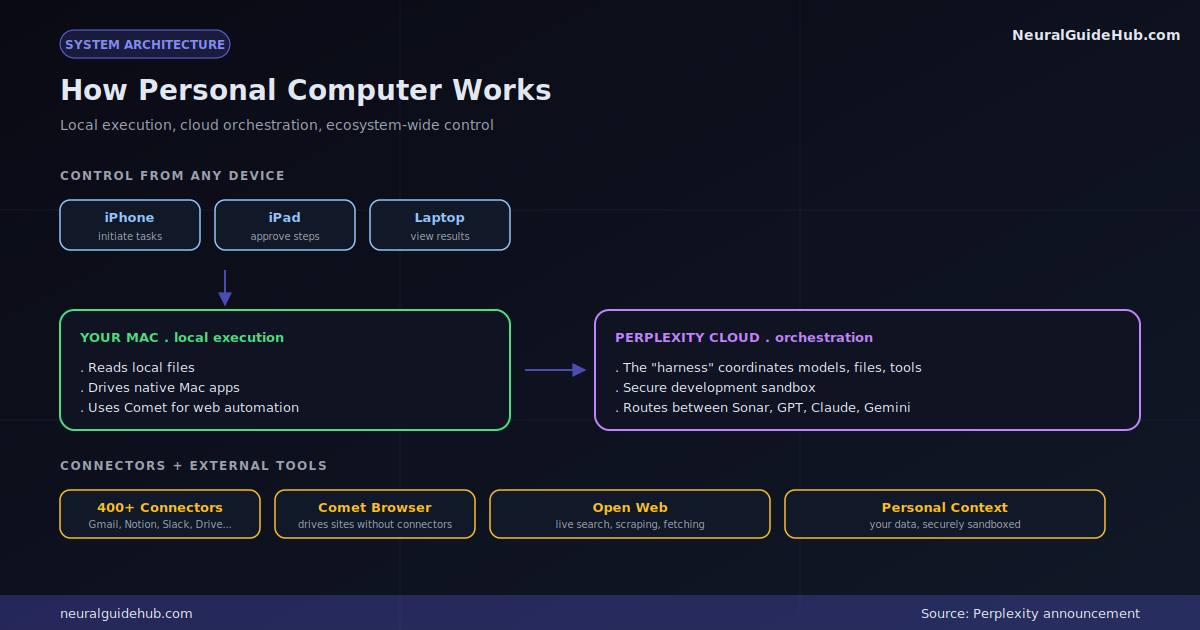
Start a task on your iPhone, have it run on your Mac mini at home, approve a human-in-the-loop step from your iPad, see results on your laptop. That continuity is the actual product, not a side feature. Apple has spent fifteen years building the device-to-device fabric. Perplexity is plugging straight into it.
The Mac mini angle is worth pausing on. Perplexity is essentially recommending you keep an always-on Mac mini at home as your “agent box.” That’s a real shift in how a personal computing setup looks. Not your laptop. Not your phone. A small box that runs autonomously while you do other things.
What It Can Actually Do
The use cases Perplexity highlights are deliberately mundane. That’s good. The boring tasks are where most knowledge work lives.
- Organize project materials across folders, tagging and renaming as it goes
- Compare two documents and write a summary of the differences
- Pull a CSV from Downloads and cross-reference it against live web data
- Assemble a draft using notes in one app and content in another
- Build a live dashboard instead of a static report
- Run continuously while you focus on something else
That last one is the unusual part. Most AI tools today are turn-based. You ask, they answer, you ask again. Personal Computer breaks that pattern. The agent keeps working until the job is done or it hits a decision point that needs you.
The Harness Story Matters More Than People Realize
Buried in Perplexity’s announcement is a phrase worth highlighting. They call their orchestration layer “the harness.” And they say something I think is correct: an agent is only as good as the harness around it.
What they mean: the model itself is mostly commodity now. GPT, Claude, Gemini, Sonar, all good enough for most agentic work. The gap between “clever demo” and “actually trustworthy outcome” sits in the system around the model. How it picks tools. How it handles errors. How it keeps state across long-running tasks. How it decides when to ask for human approval.
Perplexity’s pitch is that they’ve spent a year building that harness across Comet and Computer, and now Personal Computer inherits all of it. Whether that holds up in real use is the test.
The 400+ Connectors and the Sandbox
Two technical details that matter:
First, Personal Computer ties into 400+ connectors. That’s the same connector pool the cloud version uses. Gmail, Notion, Slack, Google Drive, Salesforce, all the standard enterprise stuff. Plus paired with Comet browser, it can drive web tools that don’t have native connectors.
Second, there’s a security architecture worth understanding. Files and tools orchestrate through a “secure development sandbox” on Perplexity’s servers. So your local Mac handles the file access and app driving, but the orchestration layer runs on Perplexity infrastructure. Data crosses the boundary, which means privacy-conscious users will want to read the fine print before pointing it at sensitive folders.
What This Means for Other AI Tools
The competitive implications are real. ChatGPT’s Mac app is a chat window. Claude’s desktop app is a chat window. Gemini doesn’t really have a native desktop presence. Perplexity just shipped something structurally different from all of them.
OpenAI announced Agent Mode for ChatGPT earlier this year, but it runs in their cloud, not on your machine. Anthropic has Claude Computer Use, which can drive a virtual desktop in the cloud. Perplexity is the first to combine “your real local machine” with “long-running autonomous agents” with “tight ecosystem integration.”
If this gets traction, expect ChatGPT and Claude to ship something similar within six months. The bar just moved.
What I’d Watch Next
A few things on my radar:
- Real-world reliability. Agent demos always look great. Day-to-day use is where most of these systems break down. The first three months of user reports will tell us whether the harness actually works.
- Pricing tier behavior. Pro and Max subscribers get credit usage tied to subscription. Free users can use the app for everyday queries. The boundary between “free use” and “agent execution” is where Perplexity has to draw a careful line.
- Windows and Linux support. macOS first is a fine choice. But agents that only work on Mac aren’t going to dominate enterprise. Watch the timeline for other platforms.
- Privacy reaction. An always-on AI that can read your local files and drive your apps is going to get scrutiny. How Perplexity handles the first major privacy concern will shape adoption.
- Mac mini sales. If the “always-on agent box” idea catches on, expect a quiet uptick in Mac mini purchases this year. Apple isn’t talking about it, but they’re benefiting.
The Bigger Shift
The framing in Perplexity’s announcement is “a calmer kind of computing.” That’s marketing language. The substantive idea behind it isn’t wrong though.
For thirty years, computing has been about active engagement. You sit at the machine. You drive it. You context-switch between apps. The agent paradigm Perplexity is shipping flips that. The machine works on its own. You check in when it needs you. The active default becomes passive monitoring.
Whether that’s actually calmer or just creates a new kind of low-grade anxiety (what is the agent doing right now?) is going to be one of the interesting cultural questions of the next year. Real users will tell us.
For now, if you’re a Mac user who does any kind of knowledge work that involves moving information across files, apps, and the web, Perplexity Personal Computer is worth installing this week. The download is on Perplexity’s website. The previous Mac app will be deprecated soon, so you’ll need the new one anyway.
And the Mac mini conversation? If you’ve been thinking about getting one for any reason, the use case just got more interesting. A small always-on box that runs your agents while you live your life. Two years ago that would have sounded like sci-fi. Now it’s a $599 purchase and a download link.
https://www.perplexity.ai/hub/blog/personal-computer-is-available-to-all-mac-users