Google dropped a science funding announcement this week that caught my attention. The Google REPLIQA initiative. Ten million dollars. Five universities. Quantum AI applied to biology. That’s the short version. The longer version is more interesting because it tells you where AI in science is actually heading next.
I’ve followed quantum computing since Sycamore. That was 2019. The field has shifted a lot. Quantum systems now do useful work in chemistry. Sometimes in biology. The hardware is still rough. The qubits still noisy. But the science is real enough that Google is willing to spend ten million dollars betting on it.
What Google REPLIQA actually is
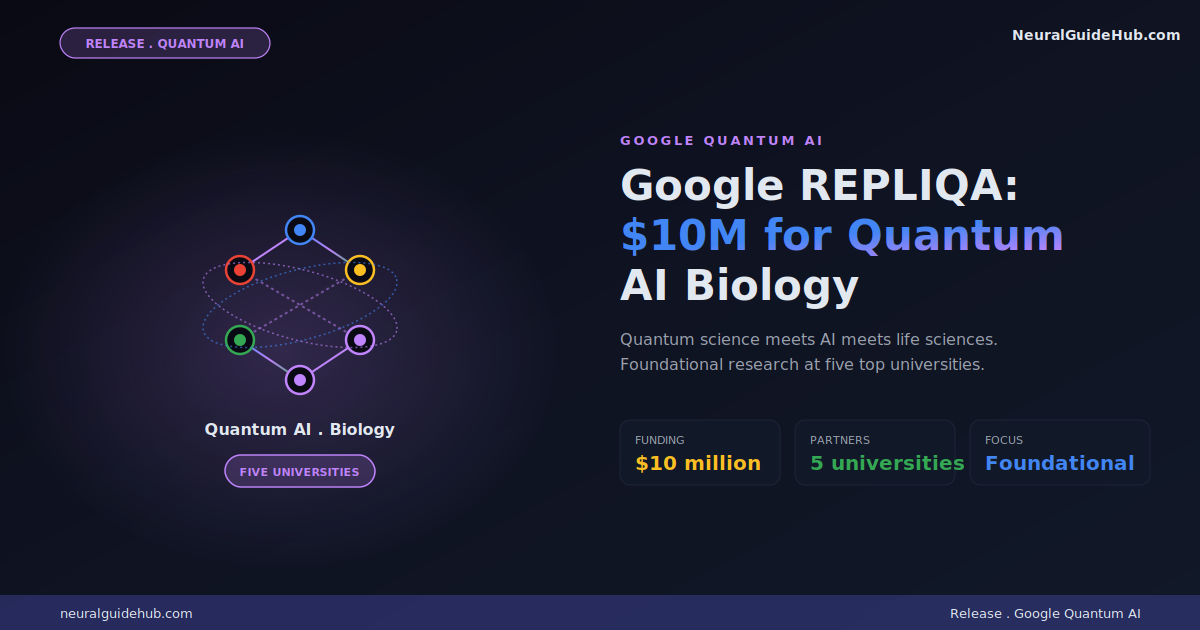
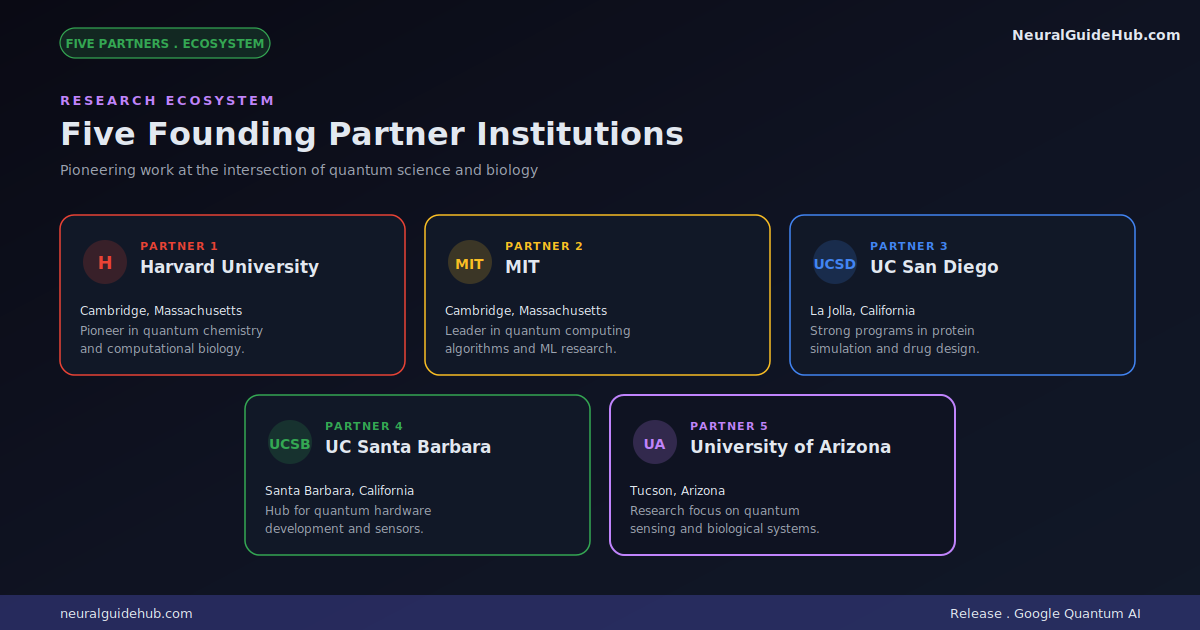
Full name: Research Program at the Intersection of the Life Sciences and Quantum AI. Mouthful. Hence REPLIQA. Funded jointly by Google Quantum AI and Google.org. The money goes to Harvard, MIT, UC San Diego, UC Santa Barbara, and the University of Arizona.
Not a typical grant. The structure tells you something. Google isn’t picking one lab to bet on. They’re funding five at once. The idea is to build an ecosystem, not pick a winner. Smart move when the science is this early.
Google says explicitly that results won’t come overnight. This isn’t about drugs in clinic next year. It’s about building the tools that future breakthroughs will need. Quantum sensors. Hybrid algorithms. Interfaces between AI and quantum hardware. The boring foundational stuff that has to exist before the exciting stuff can happen.
Why quantum for biology
Here’s the technical case in plain terms. Biology runs on molecules. Molecules run on quantum mechanics. Classical computers don’t. So when classical computers try to simulate biological processes accurately, they hit a wall fast.
Even simple molecular systems get out of reach quickly. Want to know exactly how a protein folds? How an enzyme processes a specific drug? How a cell membrane interacts with a new compound? Classical simulation can approximate. Quantum simulation can model the actual physics.
That’s the bet. Match the simulation tool to the underlying physics. The math gets cleaner. The accuracy goes up. And suddenly questions that took years of physical experiments to answer can be tested computationally first.
The P450 case study
Google’s announcement calls out the P450 enzyme family by name. Not a random pick. P450 enzymes metabolize most drugs that exist. Every pharma company cares about how these enzymes interact with their compounds.
Right now, simulating P450 reactions accurately on classical hardware is basically impossible at scale. The enzymes are too complex. Researchers use shortcuts. Shortcuts work for some compounds. They fail for others. When they fail, you find out in expensive clinical work that something didn’t behave like the model predicted.
Quantum acceleration changes that math. If you can predict drug metabolism before the clinic, you save years and millions of dollars per drug. That’s the kind of payoff that justifies betting on foundational research.
Quantum sensors are the surprise piece
The other capability Google emphasizes is sensing. Quantum sensors can now observe biological processes with precision classical instruments cannot reach. That matters more than it sounds.
Some recent experiments have suggested something genuinely weird. Quantum spin, the rotation of subatomic particles, might play an active role in how cells actually function. For decades the working assumption has been that quantum effects average out at biological scales. They wash out before they matter. Maybe that assumption is wrong.
This is where REPLIQA’s funding model earns its keep. Nobody knows yet if quantum biology is a real field or wishful thinking. Funding five labs to investigate at once gives the question a real chance of getting answered. One lab can be wrong for a long time. Five labs comparing notes can’t.
Where AI fits
Quantum systems generate insane amounts of data. Complex data. Data that humans can’t interpret directly. That’s the AI part of REPLIQA.
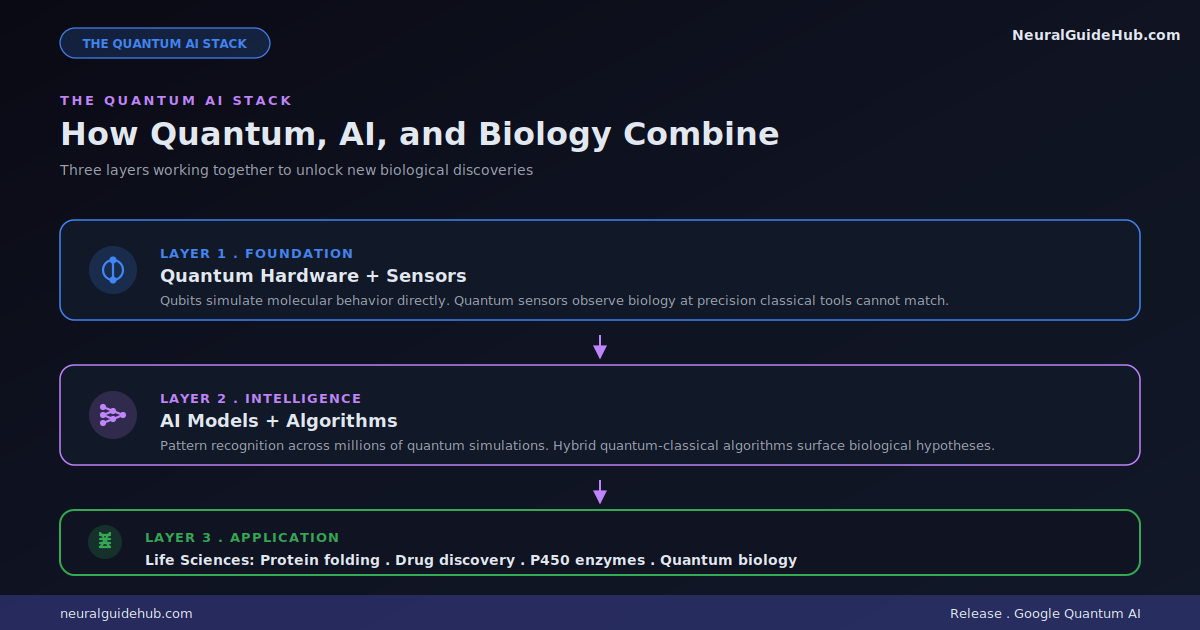
The flow works like this. Quantum systems simulate molecular behavior. AI models look at millions of those simulations. Patterns emerge. Hypotheses get generated that no human researcher would have spotted. Biologists then test the most promising ones in physical experiments. Loop closes.
This combination is where Google has structural advantages. They’ve been building quantum hardware for years. They’ve also been building frontier AI in parallel. REPLIQA is what happens when those two streams get pointed at the same problem.
Why launch this now
Reasonable question. Quantum hardware in 2026 is still early. Error rates are high. Most theoretical applications are still theoretical. So why fund the biology side before the hardware is ready?
Because the tools you need to use quantum advantage are themselves research projects. Quantum sensors need years of development. Hybrid quantum-classical algorithms need testing. Interfaces between AI models and quantum systems barely exist as productized capabilities yet. None of that builds itself.
If you wait for quantum hardware to mature before starting the science, you arrive a decade late. By funding the foundational work now, REPLIQA puts the field in position to move fast once the hardware actually catches up. That’s the strategic logic.
Open questions about Google REPLIQA
Things I’m watching for as the initiative unfolds.
How do the five labs share progress? Foundational research often gets stuck in publication races. REPLIQA’s whole premise is collaboration across institutions. Whether that actually happens depends on grant structure, IP terms, and culture. None of that is public yet.
What hardware access do funded researchers get? Google has its own quantum hardware. Access to it could massively accelerate the work. But the announcement doesn’t specify how research credits get allocated. That detail matters.
How does this interact with DeepMind’s biology work? Isomorphic Labs and the AlphaFold lineage already represent Google’s serious push into computational biology. REPLIQA either complements or duplicates that effort. Worth tracking how coordination plays out.
The bigger pattern
What I find most interesting about REPLIQA is what it signals about AI in science. Last two years were about language models. Text generation. Code generation. Useful, but not transformative for science yet.
The next chapter looks different. AI applied to actual scientific problems. Combined with specialized hardware like quantum computers. Pointed at domains like drug discovery, materials, fundamental biology. That’s where the next decade of AI value gets created. Not in chatbots.
REPLIQA is one of the cleanest examples I’ve seen of a company building toward that future deliberately. Not chasing the news cycle. Not racing to ship products. Funding the boring foundational work that makes future breakthroughs possible.
Putting ten million in context
Ten million dollars is meaningful but not transformative in scientific funding terms. The NIH spends that much on a single mid-sized project. So why does this announcement matter beyond the dollar figure?
The framing. The coordination. The signal. Google is branding an effort across five institutions as a unified initiative. That’s more than money. That’s a statement that quantum AI for life sciences is a real field worth investing in. Other companies will follow. So will other funders.
I expect more moves like this from big AI companies over the next few years. Quantum, biology, materials, energy. All domains where AI plus specialized hardware could unlock new science. Whoever funds the foundational work now builds influence in those fields for decades.
For researchers at any of the funded universities, this is a real opportunity to work at an intersection that wasn’t well-funded before. For everyone else watching, Google REPLIQA is a signal worth paying attention to. Quantum AI for biology is becoming a real field. Not whether it matters. How fast it translates to human health is the actual question.