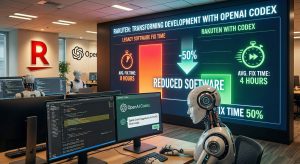
Codex isn’t just generating boilerplate anymore. OpenAI’s coding agent just helped Rakuten slash their mean time to recovery by half while automating the tedious stuff that usually bogs down software teams. That’s the kind of practical AI win that actually moves the needle.
The Numbers That Actually Matter
50% reduction in MTTR isn’t marketing fluff. It’s the difference between a two-hour outage and a four-hour one. Rakuten deployed Codex across their development pipeline and watched it tackle everything from CI/CD reviews to full-stack builds that previously took months but now ship in weeks.
But here’s what’s genuinely interesting: they’re not using it to replace developers.
Instead, Codex handles the grunt work that burns out good engineers. Code reviews for continuous integration. Deployment pipeline checks. The kind of repetitive tasks that eat up 30% of a developer’s day and contribute exactly zero creative value to the product.
Beyond the Hype Machine
Look, we’ve seen plenty of “AI will revolutionize coding” demos that fall apart the moment they hit real-world complexity. Rakuten’s approach feels different because they’re targeting specific, measurable problems rather than promising to automate entire job functions.
The company’s using Codex to:
- Automate CI/CD pipeline reviews
- Generate boilerplate code faster
- Catch common errors before they hit production
- Accelerate full-stack development cycles from months to weeks
That last point deserves scrutiny. Weeks instead of months sounds impressive, but what kind of full-stack builds are we talking about? Internal tools? Customer-facing products? The devil’s always in those details.
What This Actually Means for Development Teams
Rakuten isn’t the first major tech company to integrate AI coding assistants, but they’re among the first to publish concrete metrics about operational improvements. GitHub Copilot has millions of users, but most companies stay quiet about whether it actually makes their teams more productive or just faster at writing code that still needs human oversight.
The MTTR improvement suggests Codex isn’t just helping write code. It’s helping write better code that breaks less often and gets fixed faster when it does break. That’s a meaningful distinction.
Yet there’s still the question of technical debt. Faster code generation doesn’t automatically mean cleaner architecture or more maintainable systems. Speed gains today could create headaches tomorrow if the AI-assisted code becomes harder to modify or debug over time.
The Broader Picture
Honestly, Rakuten’s results point to something more nuanced than the usual “AI will replace programmers” narrative. They’re using Codex as a force multiplier, not a replacement. Their developers spend less time on mechanical tasks and more time on architecture decisions and creative problem-solving.
This fits the pattern we’re seeing across industries where AI adoption actually works. Companies that succeed aren’t trying to eliminate human expertise. They’re amplifying it by removing friction and automating the boring stuff that humans shouldn’t be doing anyway.
The real test will be whether these productivity gains hold up as Rakuten scales their Codex integration across more complex projects. Early wins with AI tools often plateau once the easy problems get solved and teams hit the messier edge cases that still require human judgment.