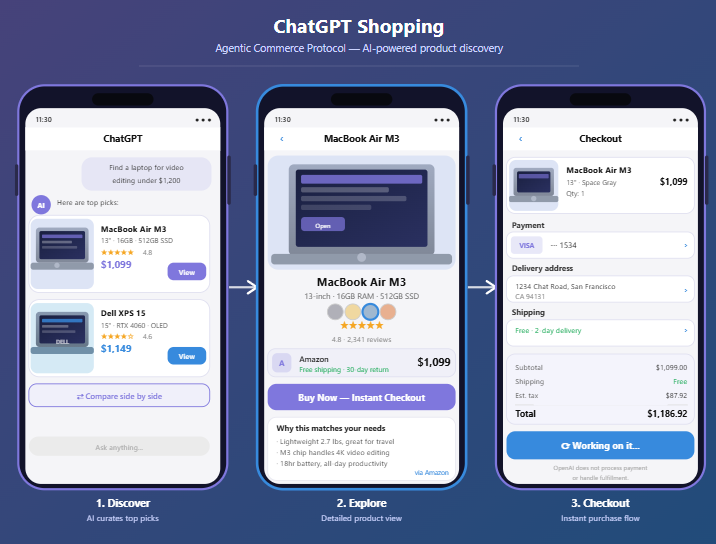
ChatGPT Transforms Into a Visual Shopping Hub With New Agentic Commerce Protocol
OpenAI has taken a significant leap into the world of e-commerce by introducing a revamped shopping experience inside ChatGPT. The update moves beyond simple text-based product recommendations and ushers in a visually rich, immersive environment where users can discover, compare, and ultimately purchase products all without leaving the chat interface. At the heart of this transformation is a new framework called the Agentic Commerce Protocol, which enables seamless integration between ChatGPT and participating merchants.
What Exactly Changed in ChatGPT’s Shopping Experience?
Previously, when users asked ChatGPT for product recommendations, responses were largely text-driven — a list of suggestions with maybe a few links sprinkled in. The new update fundamentally changes that dynamic. ChatGPT can now display products in visually appealing formats, offering side-by-side comparisons that allow shoppers to evaluate items based on price, features, reviews, and other key attributes simultaneously.
The upgraded experience includes several notable capabilities:
- Visual product discovery: Products are now displayed with images and rich media, making the browsing experience feel closer to a traditional e-commerce platform than a chatbot.
- Side-by-side comparisons: Users can evaluate multiple products at once, examining differences in specifications, pricing, and availability in a structured, easy-to-read layout.
- Merchant integration: Through the Agentic Commerce Protocol, merchants can connect their catalogs and inventory directly to ChatGPT, ensuring that product data is accurate and up to date.
- Streamlined purchase journeys: The interface is designed to reduce friction, guiding users from discovery to decision-making within a single conversational flow.
Understanding the Agentic Commerce Protocol
The Agentic Commerce Protocol is the technical backbone that makes this enhanced shopping experience possible. It is designed to allow AI agents like ChatGPT to act on behalf of users in commercial contexts fetching real-time product data, communicating with merchant systems, and potentially facilitating transactions. This represents a broader trend in AI development where models are not just answering questions but actively performing tasks in the real world on behalf of their users.
By establishing a standardized protocol for commerce interactions, OpenAI is positioning ChatGPT not just as an assistant, but as an active participant in the consumer shopping journey. Merchants who adopt this protocol gain a direct channel to reach millions of ChatGPT users at the exact moment they are considering a purchase a powerful marketing and sales opportunity.
Why This Matters for Consumers and Businesses
For everyday consumers, this update has the potential to make shopping more intuitive and efficient. Instead of jumping between multiple browser tabs, cross-referencing review sites, and navigating complex e-commerce interfaces, users can rely on a single conversational AI to guide them through the entire product research process. The AI can understand nuanced queries like “I need a laptop for video editing under $1,200 that’s lightweight enough for travel” and return curated, visually presented results that directly address those specific needs.
For businesses and merchants, the implications are equally profound. Being integrated into ChatGPT’s shopping layer means exposure to an enormous and growing user base that is actively seeking product guidance. Unlike traditional advertising where brands interrupt user activity, this model places products in front of consumers precisely when they are in discovery mode and ready to evaluate options.
Industry analysts have noted that this move signals OpenAI’s broader ambitions to expand ChatGPT from a productivity tool into a comprehensive commerce platform. It also intensifies competition with other tech giants who have long dominated the product search and discovery space, including Google Shopping and Amazon’s recommendation engine.
Expert Context: AI and the Future of Retail
The integration of agentic AI into shopping workflows has been a topic of significant discussion among technology and retail experts. The concept of AI agents that can autonomously browse, compare, and even complete purchases on behalf of users has moved from theoretical to practical with remarkable speed. OpenAI’s rollout of the Agentic Commerce Protocol is widely seen as a foundational step toward a future where AI intermediaries play a central role in how people spend money online.
Experts in the field of conversational commerce have long argued that the greatest friction in online shopping is not the checkout process but the discovery and decision-making phase. Consumers often feel overwhelmed by the sheer number of options available, and AI-powered assistants that can intelligently narrow down choices based on personal preferences and needs could dramatically improve conversion rates while reducing buyer fatigue.
There are, however, important questions that remain. Critics and researchers are raising concerns about transparency and neutrality specifically, whether AI-generated product recommendations will be truly unbiased or influenced by commercial relationships between OpenAI and participating merchants. As AI takes on a greater role in shaping consumer behavior, ensuring that users receive honest, unsponsored guidance will be critical to maintaining trust.
Looking Ahead
OpenAI’s latest enhancement to ChatGPT’s shopping features represents a meaningful evolution in how artificial intelligence interacts with the world of commerce. As more merchants adopt the Agentic Commerce Protocol and the feature set continues to mature, ChatGPT could become a go-to destination for millions of online shoppers. Whether this shift reshapes the broader e-commerce landscape remains to be seen, but it is clear that the race to build the most capable AI-powered shopping assistant is well and truly underway.