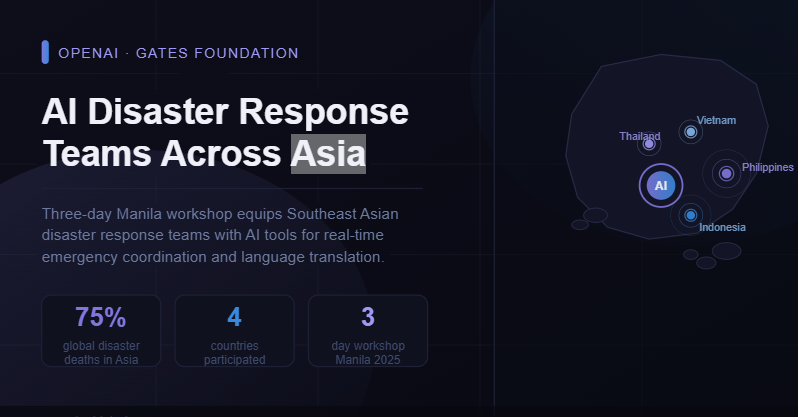
When the next typhoon slams into the Philippines or an earthquake rocks Indonesia, the difference between life and death often comes down to minutes and information. OpenAI just wrapped a three-day workshop in Manila aimed at getting AI tools into the hands of Asia’s disaster response teams, and the timing couldn’t be more critical.
The Gates Foundation partnered with OpenAI to bring together disaster response organizations from across Southeast Asia. They’re betting that AI for disaster response can help cut through the chaos when natural disasters strike a region that sees more climate catastrophes than anywhere else on Earth.
Why Asia’s Disaster Response Teams Need AI Right Now
Here’s the thing: Asia doesn’t just deal with natural disasters it gets hammered by them. The region accounts for roughly 75% of all disaster-related deaths globally, according to recent UN data. That’s not a small problem you can solve with better weather forecasts.
But the Manila workshop wasn’t about predicting storms. It focused on something more immediate: using AI to process the flood of information that comes during actual emergencies. Think about what happens when a Category 4 typhoon hits social media explodes with distress calls, satellite images pour in, and emergency services get overwhelmed with reports they can’t verify fast enough.
OpenAI’s tools can theoretically sift through thousands of emergency reports, identify the most urgent cases, and even help translate between local languages and coordination centers. That’s genuinely useful stuff.
What Actually Happened at This Workshop
The three-day session brought together teams from the Philippines, Indonesia, Thailand, and Vietnam countries that collectively face everything from tsunamis to volcanic eruptions. They worked hands-on with OpenAI’s API to build prototype applications for real disaster scenarios.
One standout project tackled something concrete: automatically categorizing emergency social media posts by severity and location. Another team built a system to help translate emergency communications between Filipino dialects and English coordination centers.
And here’s what makes this different from typical Silicon Valley “AI will save the world” theater — these organizations already know their problems. They didn’t need OpenAI to tell them what’s broken. They needed technical help building solutions.
The One Thing That Actually Impressed
Worth noting that OpenAI didn’t just show up with a PowerPoint about AI potential. They provided free API access and committed to ongoing technical support for the applications these teams are building.
But the most interesting part? The focus on local languages and cultural context. When someone in rural Philippines posts a distress call in Cebuano during a flooding emergency, that information needs to reach English speaking international aid coordinators. Fast.
The AI translation and categorization systems they’re building could actually bridge that gap in real time. That’s not world-changing tech, but it’s the kind of practical application where AI tools can genuinely help people who need it most.
The Question Nobody’s Asking Yet
So what happens when the internet goes down? Because that’s exactly what occurs during major disasters in this region the infrastructure AI depends on often gets wiped out by the very emergencies it’s supposed to help with.
The workshop materials don’t address offline functionality or how these AI-powered systems work when cellular towers are underwater and satellite connections are spotty. That’s a significant blind spot for disaster response applications.
Still, the organizations involved aren’t naive about this limitation. Many are exploring hybrid approaches that can function with intermittent connectivity store critical AI processing locally, sync when possible, fall back to traditional methods when necessary.
Why This Matters More Than OpenAI’s Other Partnerships
Look, OpenAI announces partnerships constantly, and most of them amount to PR exercises with vague promises about “exploring opportunities.” This one’s different because it addresses a concrete problem with measurable outcomes.
Either these AI tools help disaster response teams save more lives during the next major emergency, or they don’t. There’s no middle ground, no “improving efficiency” metrics to hide behind.
And the timing is crucial climate change is making natural disasters more frequent and severe across Southeast Asia. The region needs better emergency response systems, and it needs them now, not after another five years of pilot programs.
The real test won’t be whether these AI applications work in controlled workshop conditions. It’ll be whether they hold up when the next super typhoon hits and disaster response teams are running on three hours of sleep, dealing with failed communication systems, and trying to coordinate rescue operations across multiple languages. That’s when we’ll find out if this partnership was worth the effort — or just another tech industry feel-good story.
https://openai.com/index/helping-disaster-response-teams-asia