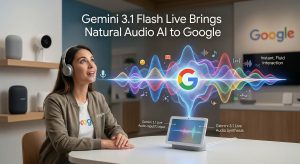
Google’s latest AI model just dropped with a feature that sounds more like sci-fi than software engineering. Gemini 3.1 Flash Live promises real-time conversational AI that can see, hear, and respond instantly through your device’s camera and microphone. That’s ambitious, even by Google’s standards.
What makes Flash Live different from the chatbot crowd
This isn’t another text-based AI assistant pretending to understand context. Gemini 3.1 Flash Live processes multimodal input in real-time, meaning it’s analyzing your voice, expressions, and surroundings simultaneously while you’re talking to it. Think of it as the difference between texting someone and having a face-to-face conversation.
The model builds on Google’s existing Gemini 3.1 Flash architecture but adds what the company calls “live interaction capabilities.” Translation: you can point your phone at a broken appliance, describe the problem out loud, and get troubleshooting advice based on both what you’re saying and what the AI is seeing. Or quiz yourself on math problems by showing your homework to the camera.
But here’s what’s genuinely impressive about the technical execution. Most multimodal AI systems process different input types separately, then try to combine the results. Flash Live appears to handle audio, visual, and contextual data streams simultaneously, which should theoretically reduce that awkward lag time that makes most voice assistants feel robotic.
The rollout strategy that actually makes sense
Google’s deploying Flash Live across its product ecosystem gradually, starting with select Google apps before expanding to third-party integrations. Smart move, considering how spectacularly AI launches can fail when they hit real-world usage at scale.
Early access is rolling out to Gemini Advanced subscribers first, then expanding to free tier users over the coming weeks. The company’s also opening API access for developers, though with usage limits that suggest they’re still stress-testing the infrastructure.
Here’s the thing though: Google’s being unusually cautious about performance claims this time around.
Previous Gemini launches came with bold benchmark comparisons and cherry-picked demo scenarios. This announcement focuses more on practical use cases and acknowledges processing limitations upfront. Either they’ve learned from past overhype, or Flash Live isn’t quite ready for the marketing superlatives yet.
Real-time AI that might actually work in practice
The use cases Google’s highlighting feel refreshingly practical rather than flashy:
- Live translation during video calls
- Real-time homework help that can see your work and hear your questions
- Interactive cooking assistance that watches what you’re doing and adjusts instructions accordingly
- Accessibility features for users who need multimodal interaction support
- Technical support scenarios where showing and telling simultaneously saves time
That last point matters more than it might seem. Anyone who’s tried to troubleshoot tech issues over the phone knows how much context gets lost in pure audio descriptions. An AI that can see your screen while you describe the problem could genuinely improve support experiences.
The accessibility applications are particularly compelling. Voice-only AI assistants exclude users with hearing impairments, while text-based systems don’t work well for people with visual or motor limitations. A truly multimodal system could bridge those gaps more effectively than current solutions.
The infrastructure reality check
Real-time multimodal AI is computationally expensive. Period. Processing high-quality video, audio, and contextual data simultaneously requires serious server resources, which means this feature will likely remain limited to users with strong internet connections and modern devices.
Google hasn’t released specific hardware requirements yet, but based on the processing demands, older phones and tablets probably won’t support the full feature set. And what happens to response times during peak usage? The company’s track record with Bard’s early performance issues suggests they’re still working out the scaling challenges.
Look, there’s also the privacy elephant in the room. Flash Live processes audio and video data in real-time, which means Google’s servers are analyzing potentially sensitive conversations and environments. The company says data processing follows their standard AI principles, but real-time multimodal data collection represents a significant expansion of what information they’re accessing.
Why this launch matters beyond the immediate features
Flash Live represents Google’s clearest attempt yet to differentiate Gemini from OpenAI’s ChatGPT and Anthropic’s Claude. While competitors focus on reasoning capabilities and text generation, Google’s leaning into multimodal interaction as their competitive advantage.
That strategy makes sense given Google’s existing ecosystem. They’ve got the hardware (Pixel devices), the platforms (Android, Chrome), and the infrastructure (Cloud services) to deliver integrated AI experiences that competitors can’t easily replicate. Flash Live feels like the first product that actually capitalizes on those advantages effectively.
But the real test isn’t whether Flash Live works in controlled demos. It’s whether the technology can handle the messy, unpredictable reality of how people actually use AI assistants. Google’s betting that multimodal interaction is the next major evolution in how we interface with AI systems. If they’re right, this could establish a new baseline for what users expect from conversational AI. If they’re wrong, it’s an expensive experiment in features nobody asked for.
https://blog.google/innovation-and-ai/models-and-research/gemini-models/gemini-3-1-flash-live/