
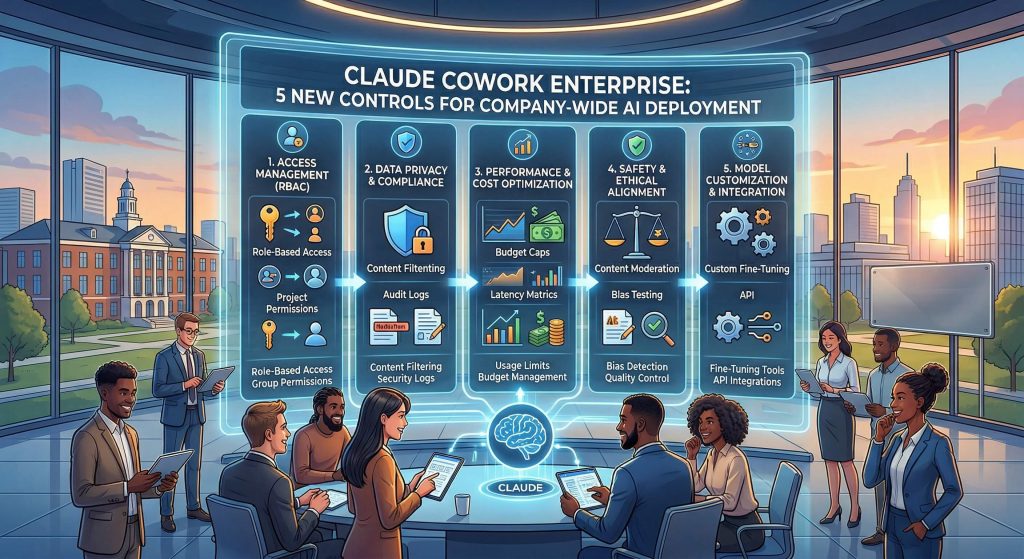
Claude Cowork enterprise deployment just got the governance layer organizations have been waiting for. Anthropic is introducing role-based access controls, group spend limits, expanded OpenTelemetry observability, and a new Zoom connector — all aimed at the question early adopters kept asking: how do we roll this out across the whole company, not just one team?
Claude Cowork is now generally available on all paid plans. The new controls land today for Enterprise customers, with several features also available on Team plans.
The Pattern Driving These Controls
Claude Code shifted developers from asking Claude questions to handing it whole tasks. Anthropic is seeing the same shift play out across the rest of the organization with Claude Cowork — and the usage data is telling.
The vast majority of Claude Cowork activity comes from outside engineering. Operations, marketing, finance, and legal are not delegating their core work to Claude. They are delegating the work that surrounds it: project updates, collaboration decks, research sprints, vendor reviews. The core judgment stays with the human. The surrounding coordination gets handled.
When this pattern emerged in one team at early enterprise adopters, they wanted to replicate it elsewhere. That created immediate questions about access, budget, and visibility. Today’s release answers them.
Claude Cowork Enterprise Controls
Role-Based Access Controls
Admins on Claude Enterprise can now organize users into groups — manually or via SCIM from their identity provider — and assign each group a custom role. That role defines which Claude capabilities its members can use. Turn Claude Cowork on for specific teams, adjust permissions as adoption grows, and keep capabilities scoped to what each function actually needs.
Group Spend Limits
Set per-team budgets directly from the admin console. Each group gets its own spend ceiling, adjustable as you learn what different teams actually consume. Predictable costs without blanket restrictions.
Usage Analytics
Claude Cowork activity now appears in the admin dashboard and the Analytics API. From the dashboard, admins can track sessions and active users across date ranges. The Analytics API goes further: per-user activity, skill and connector invocations, and DAU/WAU/MAU figures alongside existing Chat and Claude Code data.
The practical question this answers is straightforward: which teams are actually using Claude Cowork, which workflows are landing, and where does it make sense to invest next?
Expanded OpenTelemetry Support
Claude Cowork now emits events for tool and connector calls, files read or modified, skills used, and whether each AI-initiated action was approved manually or automatically. Events are compatible with standard SIEM pipelines including Splunk and Cribl. A shared user account identifier lets admins correlate OpenTelemetry events with Compliance API records.
OpenTelemetry support is available on both Team and Enterprise plans.
Per-Tool Connector Controls
Admins can now restrict which actions are available within each MCP connector across the organization. Read access can be enabled while write operations are disabled, for example. Permissions apply org-wide and are configured from the admin console — no per-user configuration required.
Zoom Integration
Zoom is launching a connector that brings meeting intelligence directly into the Cowork experience. The connector delivers AI Companion meeting summaries, action items, transcripts, and smart recordings — making it possible to take what happened in a meeting and feed it into agentic workflows without manual copy-paste.
The Zoom connector is available from the connector directory in Claude’s settings.
How Enterprises Are Using Claude Cowork
Three early adopters illustrate what this looks like in practice.
Zapier connected Cowork to their org database, Slack, and Jira to surface engineering bottlenecks. The output: a dashboard, team-by-team analyses, and a prioritized roadmap. Product and Design Ops subsequently copied the workflow for their own teams.
Jamf turned a seven-facet performance review process into a 45-minute guided self-evaluation using Claude Cowork. They then built similar workflows for vendor reviews and incident response — one pattern, applied across multiple high-friction processes.
Airtree, a venture firm, built a board prep workflow that pulls from a portfolio company’s Drive, Slack updates, and competitor news, cross-referenced against the previous prep. The research and synthesis that used to take hours gets handled by the workflow.
What Changes for Admins
The practical effect of today’s release is that enterprise IT and operations teams now have the controls they need to deploy Claude Cowork beyond a single team or pilot. Access is scoped, budgets are bounded, activity is visible, and integrations are governed at the org level.
The adoption pattern Anthropic is describing — one team adopts, others want in — suggests the bottleneck for most organizations has been governance, not capability. Today’s release removes that bottleneck.