Quantum computing has a tooling problem that does not get discussed enough. The hardware is advancing. The algorithms are advancing. But the AI models needed to actually run quantum processors reliably, calibrate them at scale, and decode errors in real time have mostly been built in-house by the handful of organizations with the resources to do so. Everyone else has been improvising.
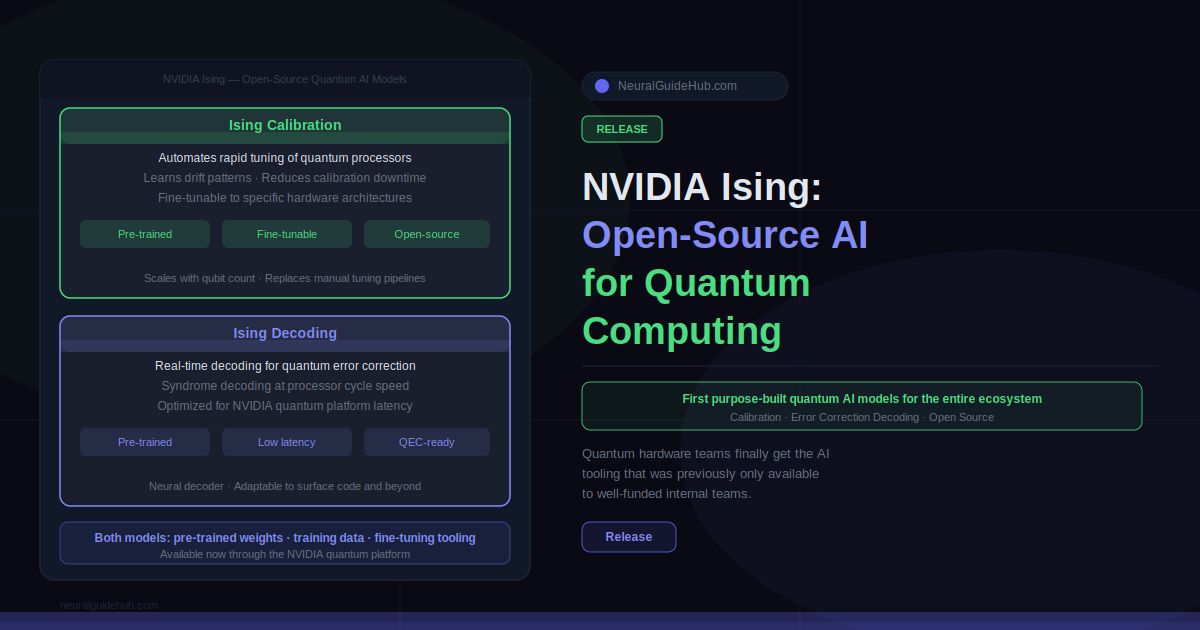
NVIDIA just changed that. NVIDIA Ising is an open-source family of AI models built specifically for quantum computing workloads, now available to the entire quantum ecosystem through the NVIDIA quantum platform. The release covers two critical workloads to start: Ising Calibration for automating quantum processor tuning, and Ising Decoding for real-time quantum error correction. Both come pre-trained, with guidelines, data, and tooling for retraining, fine-tuning, and custom deployment.
This is not a research paper or a roadmap announcement. These models are available now, and the implications for teams working at the hardware and systems layer of quantum computing are significant.
Why Quantum Computing Needed Purpose-Built AI Models
Running a quantum processor is nothing like running a classical system. Qubits are fragile. They drift. They decohere. Environmental noise, temperature fluctuations, electromagnetic interference — any of it can push a processor out of calibration within hours. Keeping a quantum system operating reliably requires continuous, precise tuning of hundreds or thousands of individual parameters.
Until now, teams doing this work either built custom calibration pipelines internally or relied on manual processes that do not scale. The same problem exists for quantum error correction. QEC requires real-time decoding of error syndromes faster than the processor can generate new ones. Classical decoders struggle to keep pace at scale. AI-based decoders can, but building one from scratch requires deep expertise in both quantum hardware and machine learning that most teams simply do not have.
NVIDIA Ising addresses both gaps with pre-trained models that any team in the quantum ecosystem can deploy immediately, or adapt to their specific hardware through the provided retraining and fine-tuning tooling.
What NVIDIA Ising Calibration Does
Ising Calibration automates the rapid tuning of quantum processors. Calibration is the process of characterizing each qubit’s behavior and adjusting control parameters to maximize gate fidelity and coherence. On current hardware, this is a time-consuming process that needs to run frequently and scales poorly with qubit count.
An AI model that can learn the patterns in a processor’s drift behavior and anticipate calibration needs, rather than running fixed-interval characterization routines, meaningfully changes the operational economics of running quantum hardware. Less time calibrating means more time computing. At scale, that difference is substantial.
The Ising Calibration model comes pre-trained on quantum hardware data and is designed to be fine-tuned on specific processor architectures. Teams with proprietary hardware can adapt the model to their system’s characteristics without building from scratch.
What NVIDIA Ising Decoding Does
Ising Decoding targets the real-time error correction layer. Quantum error correction works by encoding logical qubits across multiple physical qubits and detecting errors through syndrome measurements. The decoder takes those syndrome measurements and determines what errors occurred and how to correct them. Speed is everything here. A decoder that cannot keep up with the processor’s cycle time becomes a bottleneck that breaks the entire error correction scheme.
Neural network-based decoders have shown strong performance in research settings, but deploying one in production requires careful optimization for latency and integration with specific hardware stacks. NVIDIA Ising Decoding provides a starting point that is already optimized for the NVIDIA quantum platform, with full access to the underlying data and tooling for teams that need to push latency further or adapt to different error models.
Open Source and the Quantum Ecosystem
The open-source decision here is as important as the technical content. Purpose-built quantum AI models have existed before, but they have lived inside the internal systems of large quantum hardware companies or well-funded national labs. Smaller teams, academic researchers, and startups working on quantum software and middleware have had no access to this class of tooling.
Making Ising Calibration and Ising Decoding openly available, with training data and fine-tuning guidelines included, changes who can work at the frontier of quantum systems research. A university lab studying novel qubit architectures can now run the same calibration AI that a well-resourced hardware company might have spent months building internally.
NVIDIA’s framing here is explicitly about ecosystem-level impact. The quantum computing community advances faster when tools are shared rather than duplicated independently across dozens of organizations. That is a defensible position and one that tends to accelerate overall progress in fields where infrastructure tooling is still being established.
What This Means for Quantum Computing Teams in Practice
For teams running quantum hardware, Ising Calibration offers an immediate path to automating a process that currently consumes significant engineering time. The pre-trained model handles the baseline; fine-tuning on specific hardware data improves it further. The retraining tooling means teams are not locked into NVIDIA’s training distribution.
For teams building quantum error correction systems, Ising Decoding provides a neural decoder baseline that can be benchmarked against classical alternatives and adapted to specific surface code or other QEC implementations. The real-time performance characteristics on the NVIDIA quantum platform make it a credible option for near-term fault-tolerant quantum computing demonstrations.
For the broader quantum software ecosystem, the arrival of open, pre-trained AI models for core quantum workloads marks a maturation point. The field has been waiting for this class of infrastructure tooling to stop being a competitive moat and start being shared infrastructure. NVIDIA Ising is a meaningful step in that direction.
All models are available now through the NVIDIA quantum platform. Access to pre-trained weights, training data, fine-tuning guidelines, and deployment tooling is included in the open-source release.
https://www.nvidia.com/en-us/solutions/quantum-computing/ising/